
Should Canadian investors break up with their bond ETFs?
Since the 2022 bond bloodbath, investors have questioned bond ETFs. Learn how stock-bond correlations, diversification benefits and alternative ETF strategies affect your portfolio.


Advertisement
Since the 2022 bond bloodbath, investors have questioned bond ETFs. Learn how stock-bond correlations, diversification benefits and alternative ETF strategies affect your portfolio.

One of the biggest behavioural pitfalls investors need to watch out for is recency bias. This is the tendency to place disproportionate weight on recent events when forming expectations about the future. It can influence everything from which investments we buy to how portfolios should be constructed.
One example I’ve noticed gaining traction on Reddit is the argument that investors should break up with their bond exchange-traded funds (ETFs). We’ve previously explored a variation of this idea through the proposed 40/30/30 portfolio, which allocates 40% to stocks, 30% to bonds, and 30% to alternative investments. Its proponents argue that adding alternatives can provide better risk-adjusted returns than the traditional balanced 60/40 portfolio of equities and fixed income.
This discussion gained momentum following 2022, when an unusual combination of high inflation and rapidly rising interest rates produced historically poor returns for bonds in the same year as a stock market slump. Fixed-income investments, normally expected to provide some stability during equity market downturns, suffered substantial losses of their own. For example, according to Portfolio Visualizer, the iShares Core Canadian Universe Bond Index ETF (XBB) lost 11.67% in 2022. By comparison, the iShares S&P/TSX 60 Index ETF (XIU), which tracks 60 of Canada’s largest publicly traded companies, declined by a comparatively modest 6.36%.
Compounding the problem was the increased correlation between stocks and bonds. In 2022, XBB exhibited a correlation of 0.52 with XIU. A correlation of 1 indicates that two investments move perfectly together, while a correlation of zero indicates no linear relationship. That positive correlation meant bonds offered relatively little diversification benefit precisely when investors might have wanted it most.
It’s understandable why this experience caused some investors to question the role of bonds in their portfolios. If bonds can lose more than stocks during a bear market while simultaneously moving in the same direction, what exactly are they accomplishing?
But that’s also where recency bias raises its ugly head. The conditions that prevailed in 2022 were unusual, and extrapolating that experience indefinitely could be just as problematic as assuming bonds will always protect against equity losses.
So, should Canadian investors really ditch their bond ETFs? Let’s examine the evidence on both sides and consider some potential ETFs depending on which argument you find more convincing.
The strongest argument for reconsidering traditional bond ETFs starts with the direction of government bond yields. According to the Bank of Canada’s historical data, yields on Government of Canada marketable bonds have generally moved higher since the exceptionally low levels reached during the COVID-19 pandemic, although the increase has been interrupted by periods of declining yields.
The trend has affected different maturities, including longer-term bonds and inflation-indexed real return bonds. As of October 19, 2026, the benchmark 10-year Government of Canada bond yielded 3.93%, while the long-term benchmark yielded 4.25%. The long-term real return bond yield stood at 1.97%.
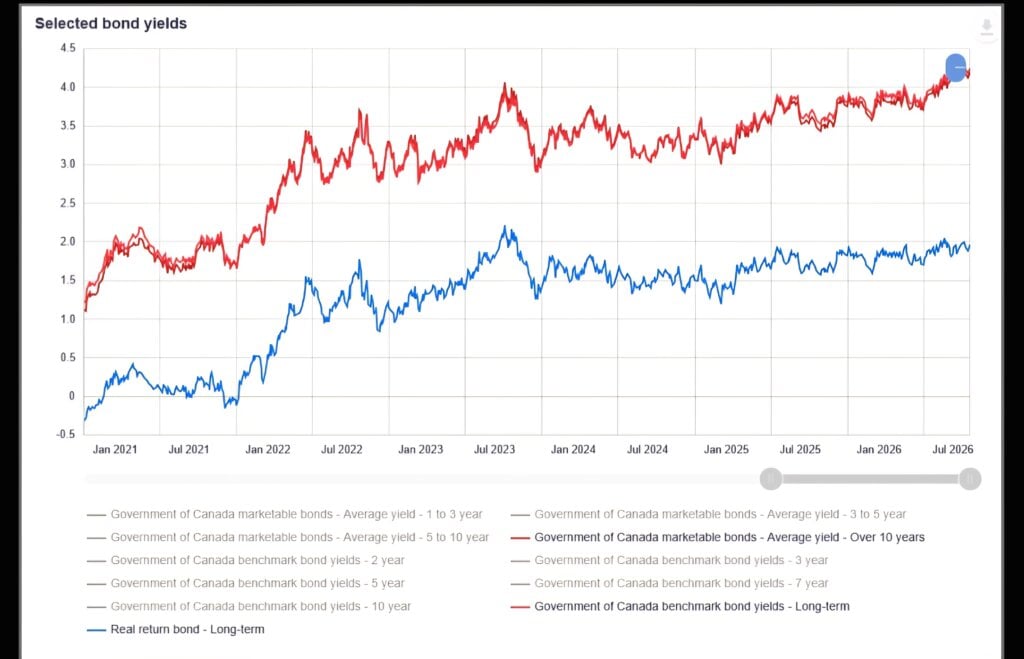
Source: Bank of Canada
Part of the explanation may be the growing concern about government borrowing and the compensation investors demand for lending over longer periods. Statistics Canada’s government finance data illustrates the pressure. In the first quarter of 2026, the federal deficit reached $19.4 billion, an increase of $3.3 billion from the same quarter a year earlier. Federal liabilities increased by $100.4 billion, including $78.8 billion in additional debt securities.
Larger deficits generally require more government borrowing. All else equal, increased bond issuance can put upward pressure on yields as governments compete for investors’ capital. Investors may also demand additional compensation for inflation uncertainty, fiscal sustainability concerns, and the possibility that interest rates remain elevated for longer than previously anticipated.
None of this necessarily means that Canadian government bonds are becoming unsafe from a credit perspective. Rather, investors can demand higher yields even from borrowers considered highly creditworthy when the inflation and fiscal outlook becomes less predictable.
Compounding this is renewed uncertainty over monetary policy. The U.S. Federal Reserve raised interest rates in September for the first time since 2023, reversing its previous easing cycle. In Canada, the possibility of a Bank of Canada rate hike at its October 28 meeting has also become increasingly credible.
Statistics Canada’s latest Consumer Price Index (CPI) report showed inflation rising 3.1% year over year in September, up from 3.0% in August and slightly above the Bank of Canada’s 1% to 3% target range. Gasoline prices were a major contributor, increasing 27.8% year over year. Excluding gasoline, inflation was considerably more subdued at 2.2%, which complicates the case for further tightening.
Still, policymakers also need to consider inflation expectations. If households and businesses begin anticipating persistently higher prices, those expectations can influence wage negotiations, spending decisions, and pricing behaviour. That raises the possibility of interest rates remaining elevated or moving higher to contain inflation.
For bond ETF investors, the concern is straightforward. Bond prices move inversely to yields. When newly issued bonds offer higher yields, existing bonds paying lower coupons become less attractive. Their market prices must fall until their effective yields become competitive with newly available securities.
The degree of sensitivity is measured by duration. XBB, for example, currently has an effective duration of 6.67 years. That means a one-percentage-point increase in yields would, all else being equal, produce a 6.67% decline in its market value before accounting for interest income and other factors.
That higher duration exposure was a major contributor to the losses experienced in 2022. And if you believe inflation will remain elevated while both policy rates and longer-term bond yields continue rising, owning an aggregate bond ETF may leave you exposed to another period of disappointing returns.
One potential solution is to reduce duration as much as possible by moving toward the short end of the yield curve. In particular, Treasury bills with maturities of less than one year have relatively little sensitivity to changes in interest rates. Their prices generally fluctuate much less, while maturing securities can be reinvested relatively quickly at prevailing short-term rates.
To illustrate this, I’ve included a Portfolio Visualizer backtest below comparing a traditional 60/40 portfolio of XIU and XBB against a 70/30 allocation of XIU and short-term cash equivalents every year from January 2022 to September 2026.
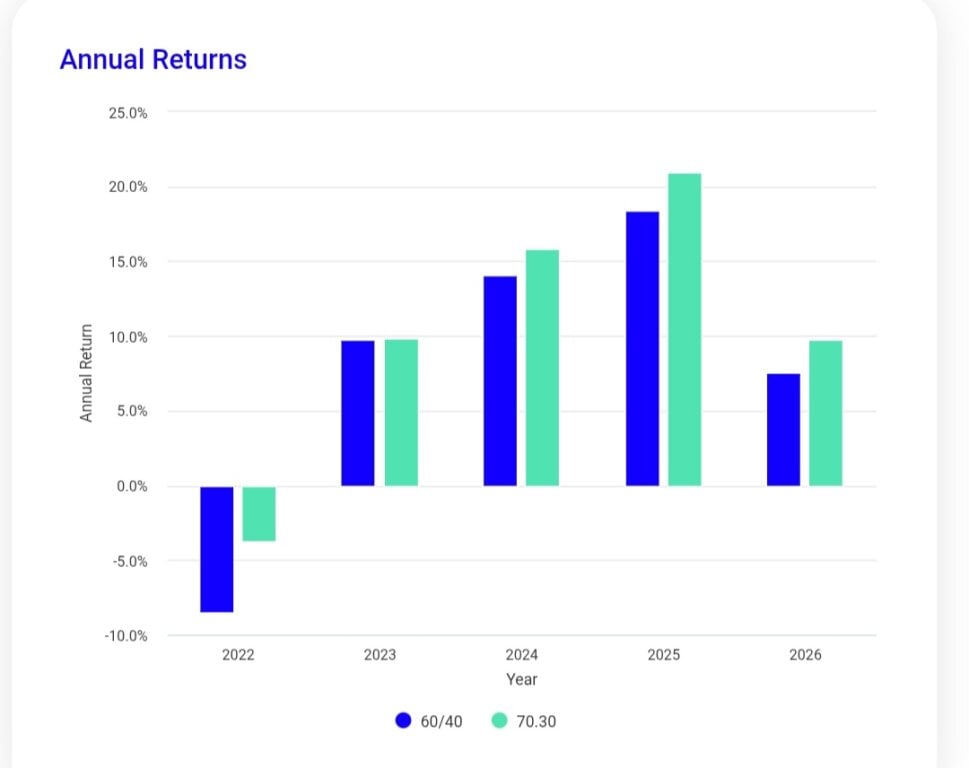
Source: Portfolio Visualizer
Of course, there is a trade-off. Short-term Treasury bills offer less potential for capital appreciation if interest rates fall sharply. Their yields can also decline quickly when the Bank of Canada cuts rates. And moving from 60% to 70% equities increases the portfolio’s exposure to stock-market losses.
For investors concerned about another inflation-driven bond selloff, that may be a reasonable trade-off. But it is worth recognizing that the resulting portfolio takes considerably more equity risk, even as it reduces interest-rate sensitivity.
Of course, constructing a portfolio based entirely on a backtest is a little like driving while looking through the rearview mirror. Investors tend to prepare for the last crisis without considering the many preceding events that might contradict their investment thesis.
There is a good reason to retain a conventional bond ETF, even after the losses experienced in 2022. High-quality government bonds can provide particularly valuable protection during a deflationary recession. This occurs when economic activity contracts alongside falling prices. Businesses and households reduce spending, unemployment rises, and demand weakens.
Unlike an inflationary environment, where central banks may need to raise interest rates despite deteriorating economic conditions, a deflationary downturn generally gives policymakers room to cut rates aggressively to stimulate borrowing, investment, and consumption.
We’ve seen versions of this throughout history, including the Great Depression of the 1930s and the global financial crisis of 2008-2009. In the latter case, collapsing demand and financial-market stress prompted central banks to slash interest rates and purchase government bonds.
A more recent example came during the COVID-19 pandemic in 2020. Lockdowns and the sudden interruption of economic activity produced a severe recession, accompanied by a sharp disinflationary shock. In Canada, the federal government responded with extraordinary fiscal support, including the Canada Emergency Response Benefit (CERB), wage subsidies, and assistance for businesses.
The scale of the monetary response was substantial. The Bank of Canada cut its overnight policy rate from 1.75% at the beginning of 2020 to just 0.25% by March 27. It also launched a quantitative easing program, initially committing to buy at least $5 billion of bonds per week. These purchases helped support bond prices and suppress longer-term yields. Meanwhile, Statistics Canada reported that annual inflation slowed from 1.9% in 2019 to just 0.7% in 2020, its lowest annual reading since 2009.
This environment was considerably more favourable for conventional bond ETFs than the inflationary conditions that emerged two years later. As interest rates and government bond yields declined, the market value of existing fixed-rate bonds generally increased. The same duration sensitivity that worked against XBB in 2022 was a potent source of capital appreciation in 2020, as seen below:
| Portfolio performance statistics | ||
| Metric | iShares S&P/TSX 60 | iShares Canadian Universe Bond |
| Start Balance | $10,000 | $10,000 |
| End Balance | $10,527 | $10,858 |
| Annualized Return (CAGR) | 5.27% | 8.58% |
| Standard Deviation | 23.94% | 7.39% |
| Maximum Drawdown | -20.23% | -3.34% |
| Sharpe Ratio | 0.31 | 1.09 |
| Sortino Ratio | 0.43 | 2.13 |
Source: Portfolio Visualizer
During this period, owning a bond allocation helped moderate the damage during the equity selloff and provided a source of relatively stable capital that could be rebalanced into stocks as prices declined. This is precisely the diversification benefit that investors want from bonds. They can behave differently from equities when the principal economic concern is collapsing demand rather than persistent inflation.
There’s also an argument that today’s macroeconomic environment offers a more attractive starting point for bond investors than the ultra-low-yield environment preceding 2022. With yields now considerably higher and many bond ETFs trading at lower prices, investors can earn more income while benefiting from the potential for capital appreciation if interest rates eventually decline.
For example, XBB is currently paying a 3.5% trailing 12-month yield versus just 2.55% at year-end in 2020. Higher starting yields also provide a greater cushion against future price losses. In that sense, abandoning bonds after their recent struggles could mean overlooking an asset class whose forward-looking return prospects have arguably improved.
Now that we’ve made the case for keeping bonds in your portfolio, that doesn’t necessarily mean you have to stick with an aggregate bond ETF like XBB despite their many advantages.
They’re generally low-cost, highly diversified, and provide exposure to hundreds or even thousands of government and corporate bonds across different maturities and credit ratings. They also make it easy to maintain a consistent fixed-income allocation without having to purchase and manage individual bonds.
However, one aspect of their construction can work against capital-preservation-focused investors who want greater certainty about when they’ll receive their principal back.
An aggregate bond ETF like XBB is designed to passively track the characteristics of an underlying bond index. As individual bonds mature or fall outside the index’s eligible maturity range, they’re removed and replaced with new bonds. The portfolio therefore maintains a relatively consistent maturity and duration profile rather than gradually approaching a final repayment date.
This can backfire when interest rates rise. If you own an individual bond, its market price will generally decline as yields increase. However, assuming the issuer doesn’t default and you don’t need to sell prematurely, you can simply hold the bond until maturity and receive its face value back. You still bear inflation and opportunity costs, but you don’t have to realize the temporary market-price decline.
An aggregate bond ETF works differently. Because it continuously replaces maturing bonds, the fund itself never reaches a final maturity date. Investors can’t simply wait until a predetermined date for the ETF to return its original principal. Rising yields can still benefit the fund over time as proceeds are reinvested into higher-yielding bonds, but there’s no fixed date at which its net asset value (NAV) is expected to converge toward a known repayment amount.
One alternative worth considering is a target-maturity bond ETF. We’ve seen more of these products launched by the asset-management divisions of major Canadian banks, including RBC, TD, and CIBC. They retain many of the familiar advantages of conventional bond ETFs, including intraday exchange trading, portfolio transparency, diversification, and regular distributions, often monthly rather than the semi-annual coupon payments typical of individual bonds.
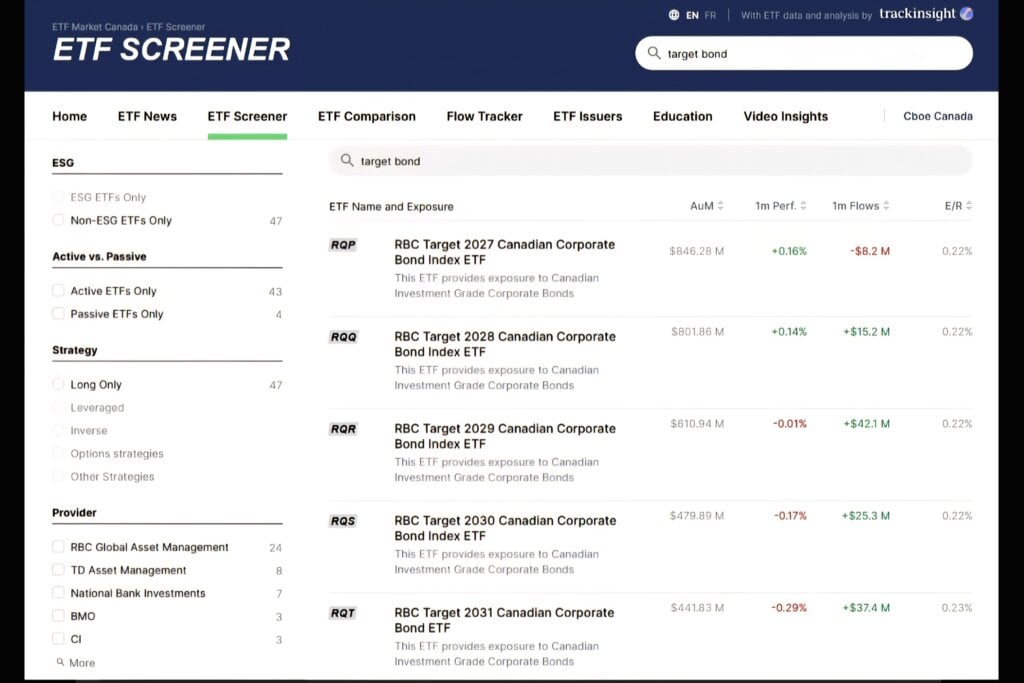
Source: Cboe Canada
The difference is that they have a specified termination year. For example, a 2027 target-maturity bond ETF generally holds a portfolio of bonds scheduled to mature around December 2027. As those securities approach maturity, the portfolio’s duration declines, reducing its sensitivity to interest-rate movements. At the end of the fund’s term, the ETF terminates and distribute its remaining NAV to investors.
This makes target-maturity ETFs particularly useful for matching investments to future liabilities. If you know you’ll need money in 2027, for example, you can select a fund with a corresponding maturity year rather than betting on the prevailing market price of a perpetual aggregate bond ETF when the time comes to withdraw.
There are still risks worth considering. Target-maturity ETFs don’t guarantee the return of your original investment, particularly if their holdings include corporate bonds that can default. Fees and the prices paid for the underlying bonds also affect the amount ultimately returned. Investors purchasing at a premium to the bonds’ face values shouldn’t expect to recover that premium simply by waiting.
Nevertheless, target-maturity bond ETFs offer a useful middle ground between owning individual bonds and holding a conventional aggregate bond ETF. They allow investors to maintain diversified fixed-income exposure while introducing a defined maturity date, making it easier to plan around future spending needs and manage interest-rate risk without abandoning bonds altogether.
Ultimately, the macroeconomic environment has an enormous influence on which investments perform well. Inflationary shocks accompanied by rising yields can hurt both stocks and bonds, as happened in 2022. Deflationary shocks accompanied by falling yields can produce a very different relationship, allowing government bonds to cushion equity-market losses.
The difficulty is knowing which environment comes next. Even professional economists struggle to anticipate turning points in inflation, growth, and interest rates consistently. Building an entire portfolio around one expected macroeconomic outcome therefore introduces a forecast that may prove incorrect.
I prefer to think of bonds as a portfolio tool. They aren’t an all-weather investment that performs well under every economic condition. But I wouldn’t treat them as a tactical position to enter and exit based on interest-rate forecasts either. Instead, investors can maintain a strategic bond allocation sized according to their time horizon, risk tolerance, and financial objectives, rebalancing periodically rather than attempting to predict the next macroeconomic regime.
Understanding the arguments for and against bond ETFs can help inform that allocation, including how much to hold and which types best suit your needs. But I would be cautious about abandoning them solely because they failed to provide diversification during 2022. Their usefulness depends on a broader range of economic conditions than any single period-specific backtest can capture.
Share this article Share on Facebook Share on Twitter Share on Linkedin Share on Reddit Share on Email


The oft-cited RRIF meltdown tactic is a distraction. Concentrate instead on leaving a bigger legacy—or giving it away right...

From dinner parties to movie nights, staying in is on the rise. Explore why young Canadians are embracing the...
David Booth’s Stay Calm lays out the latest, highly convincing case for sticking to indexing and doing less as an investor.

We’re looking at how Bitcoin and various other cryptocurrencies have fared in the second half of 2026.

Credit Canada found that 68% of Canadians don’t know how much of their budget goes toward housing. Those who...

There are still unique advantages to spousal RRSP accounts, even after the advent of pension splitting.

Yes, you can execute this combination of mortgage repayment and investing using ETFs. Your options depend on risk and...

Some Canadians will receive a payment from Veterans Affairs Canada (VAC) on Monday, September 28, 2026. The governmental department...

Financial experts reveal the money mistakes they made in their 20s and the lessons they wish they had learned...

Some expenditures stand in for the work required to actually reach our goals. Think of those before you swipe...