
Is AI the ultimate retirement hack?
Artificial intelligence is best at overcoming the friction that stops you from taking up new pursuits, users insist.


Advertisement
Artificial intelligence is best at overcoming the friction that stops you from taking up new pursuits, users insist.
There’s an interesting new book just published called I Am Not a Robot: My Year Using AI to Do (Almost) Everything. The author is Joanna Stern, who was a personal technology columnist for the Wall Street Journal for 12 years. As the subtitle of her book reveals, she spent a year using artificial intelligence (AI) for almost every conceivable task in her daily life, which included a job, raising a family, and writing the book.
The book—described in Stern’s site as an “instant NYT bestseller”—inspired me to reach out on LinkedIn and Featured.com to see whether retirees could benefit from some of these ideas, both financially in order to get to retirement in the first place and, once there, to discover how AI might be used to spend the resulting leisure time that accrues to retirees. I know plenty of retired or semi-retired friends who are writing books, playing around with AI music or art, and other creative pursuits assisted by AI tools like Chat GPT, Grok, or Claude.
While my family members dabble in some of these tools, I confess I’ve not yet immersed myself in them, although I find AI to be an interesting theme as an investment, if only through an exchange-traded fund like AIS, the VistaShares Artificial Intelligence Supercycle ETF. (Its top holdings are the usual tech/semiconductor suspects: Nvidia, Micron, Intel, Taiwan Semiconductor, AMD, SK Hynix, GE Vernova, and another 50 or so names.)
Stern’s book came to my attention via an interview with Jim Cramer in his Mad Money podcast. Cramer himself appears to be immersed in every AI tool from Claude to Google’s Gemini.

Build your retirement savings with 1.50% interest, tax-deferred contributions and zero fees.
Earn a guaranteed 3.70% in your RRSP when you lock in for 1 year.

See our ranking of the best RRSP accounts and rates available in Canada.
MoneySense is an award-winning magazine, helping Canadians navigate money matters since 1999. Our editorial team of trained journalists works closely with leading personal finance experts in Canada. To help you find the best financial products, we compare the offerings from over 12 major institutions, including banks, credit unions and card issuers. Learn more about our advertising and trusted partners.
Stern certainly doesn’t think every AI app is worth the bother or expense (they’re not necessarily free even if, as in the drug world, the first hit is free). If you’re still in the workforce or a young person just getting started, there’s little doubt you’ll have little choice but to embrace this technology. As Nvidia president and CEO Jensen Huang has said, workers don’t necessarily have to fear losing their jobs to AI but they should fear losing their jobs to other employees who know how to use AI.
Certainly, AI is having a huge impact on those just starting out in their working careers, and probably those in mid-career as well. As Stern points out, nearly 80% of organizations reported using AI in at least one part of their business by early 2025. As an author, she’s brutally honest and often quite funny. Early on she admits she is “genuinely optimistic about technology and how it can improve our lives.” Even so, once she tried to incorporate AI into every aspect of her life, she discovered “a lot of these tools suck.”
In all, Stern tested more than 100 AI tools, from chatbots to wearables to self-driving cars and home robots. Her self-imposed rule was to keep using something if it was useful; if not, she dropped it. She also tracked costs: “Many of these AI tools cost something, even if some of them started with a free trial, which quickly turned into a monthly subscription.”
In places, she’s quite critical of how some professionals use AI against consumers. An example is dentistry: “Some dentists are using AI to upsell the crap out of us.” Or as she says, “Dentistry is part science, part art, and part business.” Even so, she is a bit more encouraging about AI’s role in the broader medical profession. Within two years, she predicts, “you should never sit and talk to a doctor without an LLM [Large Language Model] being in the meeting… AI is a good second opinion… It’s clear that a ‘doctor alone’ is not as good as either ‘AI alone’ or ‘doctor plus AI.’”
While Chat GPT and Claude or other LLMs can be used to help with investment advice, Stern also tested more focused AI tools, such as Arta, a wealth management startup testing AI financial planners, and Cleo, an AI financial assistant app.
Retirement or semi-retirement is different than the working world, which is why I was curious about how AI can help retirees with their leisure and creative pursuits, travel, and even senior dating. Ironically, and as the first source selected below points out, “Retirees have an edge most working folks don’t: time to actually learn the tools.”
Stern touches on the creative aspect of AI, too, having evaluated AI music tools like Suno or Udio, which use generative AI to create songs. She abandoned them after two weeks, concluding that AI music is at its best when paired with humans and their creative prompts. She also tried Otter.ai, an AI transcription firm that offers tools that can “attend” meetings for you, record, and summarize them (something I have briefly experimented with myself). In video, Stern tried out Sora, which is OpenAI’s video model and app, to create short videos or deepfake videos of yourself called “cameos.”
She closes her book with six rules for living in an AI world, starting with “working with AI, not for it. “Use it to move faster, spark ideas, automate the boring parts. But keep your weird, wonderful human judgement in the loop.”
When I posted an invitation to share ideas on Featured.com, I was surprized how many sources responded with their thoughts on AI and retirement: more than 50. I chose 17 of them, which you can read in full on my website, Findependence Hub.
In the normal space allotted to this Retired Money column, I can only touch on some of the headlines of those quotes, knowing interested readers can get the full version online. Most respondents mentioned health, finances, travel, senior dating, and creative pursuits facilitated by AI. More than one quipped that while coming up to speed on AI can be time-consuming, retirees should have plenty of leisure time to take advantage of it, unlike those still consumed by the workaday world.
Wayne Lowry, CEO of Scale By SEO, put it well: “Retirees finally have something working folks don’t: time to actually learn the tool instead of just bolting it onto a busy day. That’s the unlock. AI rewards curiosity and iteration, and retirement is the perfect runway for both.”
Neill David Watson, Founder of APMZEE, observed that “the pattern I see is that people don’t lack interests later in life; they lack the patience for the friction, the research, the logistics, the learning curve that sits between ‘I’d like to’ and ‘I started.’ That friction is exactly what these tools dissolve.” Whether it’s learning to play a musical instrument, sketching out a plan to start a small business, or writing the great American novel, “AI can compress the daunting setup into a first step you’ll actually take.”
Retirement is the ultimate unlock for AI, says Runbo Li, CEO of Magic Hour AI: “Most people over 60 don’t realize they’re sitting on the best possible use case for these tools. Here’s why: AI eliminates the learning curve. The thing that used to stand between ‘I want to paint’ and actually painting was years of skill-building. That barrier is gone.”
After going through all these responses, my impression was that using AI in retirement could itself become another full-time job. As is the case during our working years, it helps to prioritize. Most of the respondents see health and finances as the essential places to start.
“Start with finances, because it’s the highest-stakes lane,” argues marketing coordinator Melissa Basmayor of Freeqrcode.ai: “Tools like ChatGPT or Claude won’t replace a fiduciary, but they’re incredible for stress-testing your understanding. Paste in a fund prospectus and ask it to explain expense ratios in plain English… Ask ‘what questions should I be asking my advisor that I’m not?’ That last prompt alone is worth a year of subscriptions.”
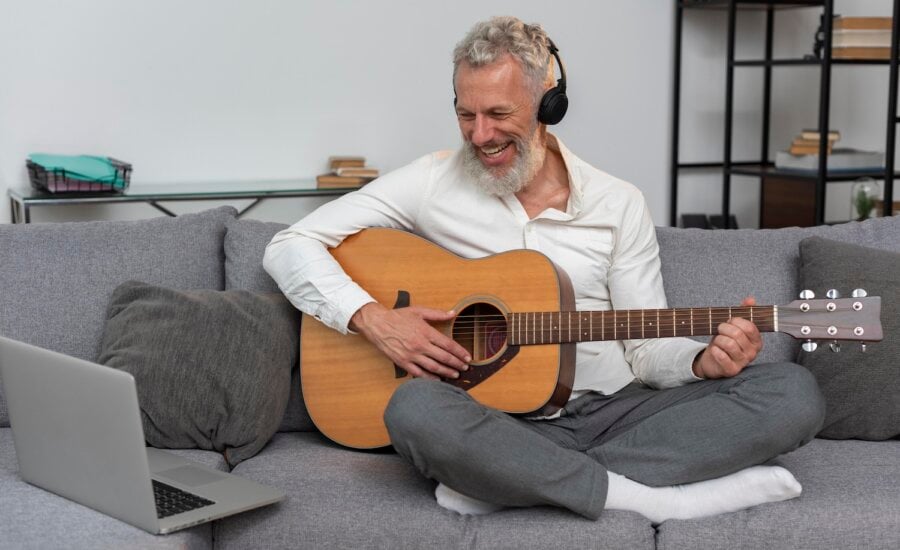
If overwhelmed about where to start, one useful suggestion came from the aforementioned Wayne Lowry: instead of starting with a particular AI tool, begin with a real question you want answered. “For creativity, treat AI like a curious co-pilot. Retirees finally have time to write the family memoir, paint, or learn guitar. Ask it to draft a chapter outline from your stories, suggest chord progressions, or critique a poem. The magic isn’t replacing your voice, it’s getting unstuck on a Tuesday afternoon.”
A similarly practical recommendation comes from Dane Maxwell, founder of Paperless Pipeline: use AI tools that “solve a friction the older user already feels.” In his experience, those over 60 are generally engaged with tasks like voice transcription, calendar management, photo organization, document summarization, and travel itinerary planning. “AI for retirees works when it amplifies what they already want to do. It fails when it demands they learn a new identity as a ‘tech user.’”
Personally, I suspect I won’t immerse myself in creative AI projects until I’m fully retired. Right now, I’m happy to research AI and absorb the endless news on its effects on the workforce, productivity and government policy. Where it makes sense, I will continue to invest in certain AI stocks within the scope of a well balanced, diversified portfolio. On the creative front, I may dabble in things like AI music; and while it’s been a long time since I contemplated writing another book (whether fiction or non-fiction) I will certainly enlist AI if and when that time comes. I suspect this column and the longer version of the blog could easily be the start of a full-length non-fiction book.
In the meantime, we’ll give Wayne Lowry the last word: “Treat AI like a brilliant intern: fast, eager, occasionally wrong. Trust comes from checking the work, and that’s a skill retirees already have in spades.”
Share this article Share on Facebook Share on Twitter Share on Linkedin Share on Reddit Share on Email


From dinner parties to movie nights, staying in is on the rise. Explore why young Canadians are embracing the...
David Booth’s Stay Calm lays out the latest, highly convincing case for sticking to indexing and doing less as an investor.

We’re looking at how Bitcoin and various other cryptocurrencies have fared in the second half of 2026.

Credit Canada found that 68% of Canadians don’t know how much of their budget goes toward housing. Those who...

There are still unique advantages to spousal RRSP accounts, even after the advent of pension splitting.

Yes, you can execute this combination of mortgage repayment and investing using ETFs. Your options depend on risk and...

Some Canadians will receive a payment from Veterans Affairs Canada (VAC) on Monday, September 28, 2026. The governmental department...

Financial experts reveal the money mistakes they made in their 20s and the lessons they wish they had learned...

Some expenditures stand in for the work required to actually reach our goals. Think of those before you swipe...

When bond yields rise, the effects ripple through the rest of the economy, and Canadians should take note. ...
Thank You Jonathan for reading the books about retirement, investing and all else. I am 58 and after my workday is done (7 hours in front of 3 computer screens) I don’t sit in front of my pc. I walk my Guidoune and do other things….for my mental health. Your insight is much appreciated.