
What is money actually for?
Columnist Vickram Agarwal spent more money than he ever thought he would on two Oasis concerts. The spreadsheet hated the decision, but he doesn’t.


Advertisement
Columnist Vickram Agarwal spent more money than he ever thought he would on two Oasis concerts. The spreadsheet hated the decision, but he doesn’t.
There is a squirrel that works the patch of grass outside my car most mornings. I see it during the 20 quiet minutes I keep for myself before the day begins, coffee in hand. For weeks, I’ve watched it do the same thing over and over: burying something, pausing, then darting off to bury the next one a few feet away. It looked like the most diligent creature alive.
What I did not know until I read about it later is that squirrels forget. They bury far more than they ever dig back up, and many of those acorns are never recovered at all. Some of them quietly become the trees that will one day feed a squirrel that has not been born yet. The diligence I had been admiring was real, but so was the forgetting, and the two turned out to be inseparable.
I have thought about that small act of forgetting more than I would like to admit, because there is something uncomfortably human in it. We spend so much of our lives preparing for the future that we sometimes lose sight of what we were preparing for in the first place. We save, we invest, we delay gratification, and we make the responsible decision repeatedly until, somewhere along the way, responsibility quietly becomes the goal itself. We become the squirrel, so busy storing acorns that it forgets to eat.
Last week, I wrote about my daily $1.92 Tim Hortons decaf and argued that sometimes the spreadsheet is wrong. That little ritual was never really about the coffee, but about buying myself those 20 uninterrupted minutes, squirrel and all. While I was writing it, I got to talking with my colleague and friend Jessica about the bigger version of the same question—the once-in-a-lifetime purchases that conventional personal finance wisdom warns us against. For her, it was flying to Europe for Taylor Swift’s Eras Tour. I laughed when she told me, because I had just done something remarkably similar.

Scotiabank Gold American Express Card

American Express Cobalt Card

MBNA Rewards World Elite Mastercard
The way Jessica describes the decision is the part I keep coming back to. She had missed out on tickets at home, could not justify the North American prices, and found herself one night scrolling through other fans’ videos, in her words, just dying inside that she could not be there. European tickets turned out to be a fraction of the cost, so she pulled up flights and sat with it for about 10 minutes. Then, she asked herself a single question: was she more likely to regret spending the money, or regret missing the concert? She booked the flight, and then, she admits, cried for half an hour out of pure excitement.
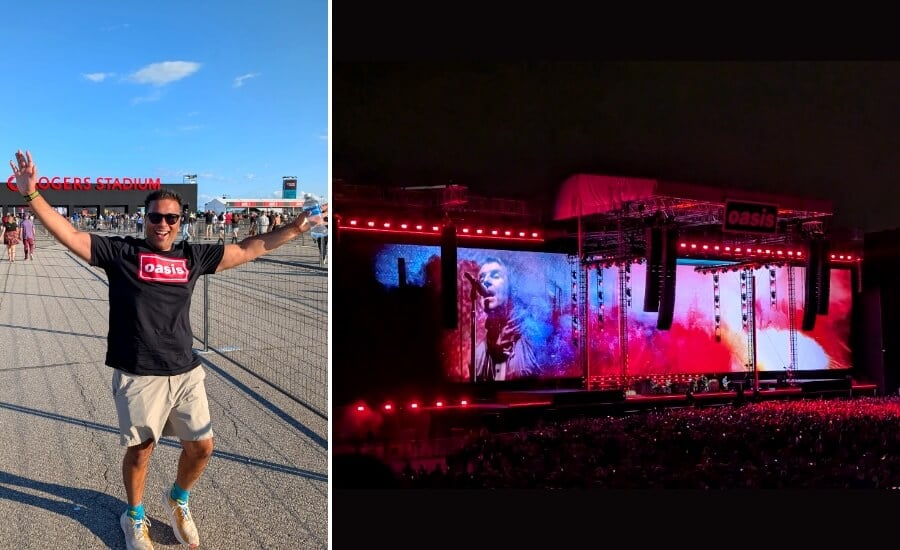
Mine was Oasis. Not one night, but two, back-to-back, in the most expensive seats I could buy, with more merchandise than I have ever purchased for anything else in my life. I dragged my wife along to the first night despite the fact that she is not really a fan, made my dear friend Katy wait beside me for two hours at the Oasis pop-up shop in London last summer, and then queued for another two hours in the Toronto sun a few days before the show—just for the merch.
If you had met me 20 years ago, you might not believe that sentence.
In my early twenties, a series of badly timed investments forced me to start over financially. Then came the life of a perennial entrepreneur, aspiring to something bigger while living far smaller than most people imagined. Those years taught me discipline, resilience, and resourcefulness, and they also left me with a relationship with money built almost entirely around caution. Money came in, the bills were paid immediately, savings and investments were prioritized, and whatever remained—if anything remained—was what I allowed myself for the occasional indulgence.
Most people would call that responsible, and they would probably be right. But responsibility has a shadow side we do not talk about often enough. When it becomes your entire financial identity, it can quietly convince you that spending money on yourself is something that always requires a defence.
When everyone around me was upgrading, the new cars and the renovated patios, I felt like the squirrel hoarding against some tough season I was sure was always just around the corner. For years, I lived exactly that way, always storing, always preparing, until eventually I could no longer remember what I was preparing for.
Then, Oasis announced their reunion.
I first saw Oasis in 2005, while I was studying in Cardiff, Wales. A few years later, they broke up, and like millions of fans I assumed that chapter had closed for good. Between that night and this one, almost everything about my life changed. I moved countries a few times, got married, became a father, and built businesses that variously succeeded and struggled. I lived through financial setbacks that reshaped how I thought about money, and many professional successes that once felt impossible. Twenty years have passed.
So, those tickets were not simply admission to a show; they were a way of acknowledging the distance between the person I had been and the person I had become.
Could I have bought cheaper seats? Of course. Gone for one night instead of two, skipped the merchandise entirely? Without question. The optimizer inside me suggested every one of those alternatives, and for once it lost. Not because I abandoned the financial principles I believe in, but because I finally understood that I was not buying a product. I was marking a milestone, and that distinction matters more than the optimizer wants to admit.
When we talk about investing, we almost always mean money put into assets that produce financial returns, whether stocks, real estate, a business, or an education. Those are all worthwhile, but somewhere along the way, many of us started believing they were the only investments that counted. What if that is not true?
What if some of the most valuable things we ever spend money on are precisely the ones that produce no return a spreadsheet could ever measure?
Jessica told me she still thinks about that weekend almost every day. She talks about the show the way people talk about the few nights that rearrange something in them: tens of thousands of fans inside the stadium in Munich and tens of thousands more gathered on the hills around it, all singing the same words at once. When certain songs come on now, she is transported straight back.
But the part that stuck with me was not the concert, it was what she said the trip gave her beyond it. She went alone. Her twenty-something self, she told me, would never have flown halfway around the world for a concert by herself, but her thirty-something self was confident enough to spend the money and do something gloriously impractical simply because she wanted to. What she carried home was not the setlist, but the realization that she did not need anyone else’s permission, or even their company, to go and have an adventure

That stayed with me, because it named something I had been wrestling with for years. I had become remarkably good at giving everyone else permission to enjoy life, my wife, my daughter, our friends and family, my colleagues, even complete strangers. The only person I rarely extended that same generosity to was myself.
It is tempting, at this point, to call Oasis an investment in the conventional sense. In a way, it even felt like one. I came home happier than I had been in years, my work felt lighter, my creativity came back, and my business performed unusually well in the months that followed. But that is not why the concerts were worth it, and I want to be careful here. If I need a bump in productivity to justify an experience, then I am still letting the spreadsheet decide whether I am allowed to live. Some things are valuable simply because they enrich your life. Not every meaningful purchase needs to earn its keep.
That does not mean every expensive purchase deserves a free pass. Far from it. I am not suggesting anyone finance experiences they cannot afford, ignore their debts, or trade long-term security for a weekend of excitement. I paid for the concerts outright, and they did not come at the expense of my family’s savings, our goals or our future. Intentionality still matters. Affordability still matters. The squirrel still needs its acorns for winter. It also needs enough nourishment to survive until winter actually arrives.
When I asked Jessica how she decides whether a big indulgence is the right call, she had a rule ready. It was not a number; it was a question. Will I regret not doing this? Not the short-term fear of missing out, but the longer kind: in a year, will I still be thinking about the thing I passed up? If the answer is yes, she figures, it is probably worth it. She knew that if she skipped the Eras Tour, she would be in her forties and still thinking about it. I recognized the test immediately, because the two nights of Oasis would have failed me in the same way. Some opportunities do not come back, and pretending otherwise is its own kind of cost.
That balance is easy to forget, because personal finance tends to celebrate only one side of the equation. We admire the saver, the optimizer, the person who wrings every last dollar of future value out of the present. Those habits deserve their recognition. So do the moments when someone deliberately chooses to enjoy the life they have spent decades building.
That instinct may be more widely shared than we think. According to a recent PayPal Canada survey, 44% of Canadian adults said they would rearrange their discretionary spending to attend matches or take part in the experiences around the FIFA World Cup 2026. People are not simply buying tickets. They are buying the memory, the connection, and the chance to say, years from now, that they were there. It does not mean every experience is worth any price, but it suggests that most of us intuitively understand something personal finance does not always capture.
Money is not only about accumulating wealth. It is about using that wealth to build a life.
When I asked Jessica what she would say to someone who wants the experience but feels guilty about the price, she did not hesitate. Not every purchase has to be the most financially responsible decision you will ever make, she said. You must find the balance between preparing for your future and living now, and if something is meaningful to you, guilt should not be the thing that stops you. You will carry the memory far longer than you will remember the dip in your bank balance. I have come to believe she is right.
I do not think it is simply for maximizing net worth. It is for creating security, for opening opportunities, for looking after the people we love. And sometimes, once the bills are paid and the savings are still growing and the responsibilities have all been met, it is for giving ourselves permission to stop being the thief of our own joy.
The squirrel outside my car will go on burying its acorns, and it will go on forgetting where it left a few of them, and some of those will quietly grow into trees it will never see. It is wise to store for winter. I just no longer believe the price of that wisdom should be a whole summer spent hungry.
I continue to ponder, what is money actually for?
Share this article Share on Facebook Share on Twitter Share on Linkedin Share on Reddit Share on Email


Which ETFs should you invest in? Which ones best suit your risk tolerance? What about personal ethics? Check out...

Some Canadians will receive a payment from Veterans Affairs Canada (VAC) on Monday, September 28, 2026. The governmental department...

Ikea is leaning into low prices, used furniture, and cheaper meals as Canadians face higher living costs.
FAIR Canada says Canada should maintain restrictions on prediction markets unless broader access is shown to benefit investors and...
Financial experts reveal the money mistakes they made in their 20s and the lessons they wish they had learned...

We plan for the future based on what worked in the past. But what happens when the next generation...

Some expenditures stand in for the work required to actually reach our goals. Think of those before you swipe...

When bond yields rise, the effects ripple through the rest of the economy, and Canadians should take note. ...

What retirement experts have to say now about surviving an untimely market crash.
Eligible for CPP and OAS/GIS? Here’s how much money you can expect this week.
Thank you for an incredibly insightful, meaningful, well-articulated column. Although I can now afford to treat myself with an occasional gift (tangible item, or experience) I’ve been finding it difficult to make the transition (feels more like a leap) from decades of saving/allocating towards responsible financial management in the pursuit of self-sufficiency. Old habits are hard to break, but sharing your wisdom regarding your own experience has made a significant impact. Truly, an aha moment.