Will Bitcoin soar or crash in 2026? 2025 was a rollercoaster ride for the cryptocurrency, which started strong but ended softer. 2026 promises more uncertainty on the back of geopolitical unpredictability.
Advertisement
Image from Freepik
Welcome to the Canadian Crypto Observer. Financial journalist and author Aditya Nain offers perspective on market-moving headlines to help Canadian investors navigate the cryptocurrency market.
Advertisement
Advertisement
2025 was a milestone year for BTC and other cryptocurrencies. The passing of the GENIUS Act in the U.S., which regulates U.S. dollar stablecoins, confirmed crypto’s status as a mainstream asset. Equally important was the proliferation of cryptocurrency exchange-traded funds (ETFs) in Canada, the US, and other countries. Investors no longer need to jump through hoops or navigate the crypto ecosystem to invest in BTC, ethereum (ETH), Solana (SOL) or other cryptocurrencies. Now, getting exposure to crypto is as easy as buying an S&P 500 Index ETF or a S&P/TSX Composite Index ETF.
How did BTC perform as an investment in 2025? Although it was down a relatively modest 7.32% from the beginning to the end of 2025, investors experienced wild up and down swings through the year. Here’s how much BTC gained or lost in each quarter of 2025.
Closing price on the first day of the quarter (A)
Closing price on the last day of the quarter (B)
% change from (A) to (B)
Q1 (Jan–Mar)
$94,419
$82,548
(12.57%)
Q2 (Apr–Jun)
$85,169
$107,135
25.79%
Q3 (Jul–Sep)
$105,698
$114,056
7.90%
Q4 (Oct–Dec)
$118,649
$87,508
(26.34%)
Closing price on the first day of the year (C)
Closing price on the last day of the year (D)
% change from (A) to (B)
Entire year (Jan–Dec)
$94,419
$87,508
(7.32%)
What the Venezuela crisis means for BTC
2026 is off to a wild start. The US special forces entered Venezuela, captured the country’s leader Nicholas Maduro and his wife, Cilia Flores, and flew them to New York to face charges.
How does this affect BTC? BTC trades in two ways: sometimes as a safe haven asset like gold, and other times like a technology stock that rips higher in times of market optimism and exuberance. In the weeks since this year began, BTC has traded like a safe haven asset, gaining on the back of rising geopolitical tensions exemplified by the US military action in Venezuela.
From the beginning of 2026 to now (mid January 2026) BTC has gained over 8% and gold is up about 5%. Why so? Much of the geopolitical uncertainty these days is caused by actions taken by, or statements made by the US government. As a result, investors are on the lookout for assets that are—at least partially—independent of US government influence.
Enter gold and BTC. They’re both globally traded assets that aren’t structurally controlled by the US—or any other country. Further, both are considered by many investors to be alternative forms of money. In fact, gold and BTC are often clubbed together as hard assets; that is, assets the value of which cannot easily be manipulated or inflated by governments, including the US.
Does this mean that the price of BTC will continue to rise this year as long as geopolitical uncertainty persists? It’s not that simple.
BTC’s fate in 2026 will depend on inflation and interest rates
While BTC—like gold—does rise on the back of geopolitical uncertainty, it is also (somewhat paradoxically) considered a risk-on asset. In other words, just like stocks, it gains substantially in low-interest rate regimes when the market is flush with liquidity. Therefore, for BTC to gain substantially in 2026, inflation (especially in the US, which is the world’s largest capital market) would need to be soft and interest rates would need to remain low.
Article Continues Below Advertisement
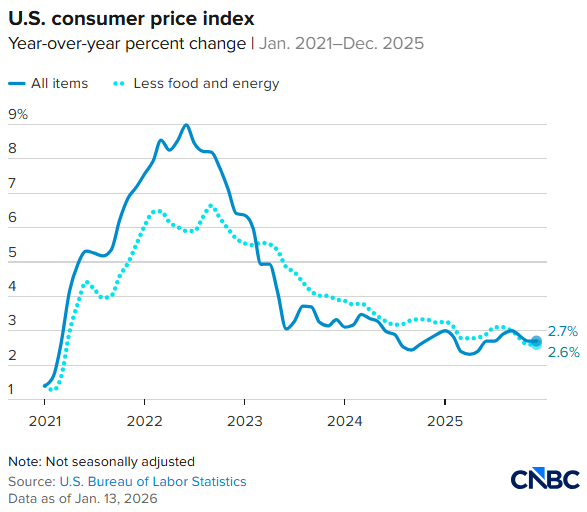
US inflation data right now is encouraging, with the headline U.S. consumer price index (CPI) for December 2025 coming in at 2.7% on an annual basis. This is in line with expectations and within the U.S. Federal Reserve’s (the Fed’s) comfort zone—which means that the Fed may not be in a hurry to raise interest rates. This is positive news for BTC.
The chart below shows the CPI trajectory from 2021 to the latest print for December 2025. As is clear from the chart, CPI has remained relatively low—within the 2% to 3% band—for well over a year on the back of soft crude oil prices and efficiency gains from the adoption of artificial intelligence (AI).
Where BTC goes in 2026 will in no small part depend on the price of oil, the continued adoption of AI by large global companies, and the effect these will have on inflation.
Crypto price swings are common
Cryptocurrencies including BTC, ETH, XRP, SOL, BNB, and others are speculative and highly volatile assets subject to significant price movements. Even stablecoins, which are seemingly “safe,” may be risky if not adequately backed by real-world assets.
Investing in bitcoin and other crypto coins carries significant market, technological, and regulatory risks. Invest in crypto only if it aligns with your broader investment goals, time horizon, and risk profile, and always stay vigilant about crypto scams.
Newsletter
Get free MoneySense financial tips, news & advice in your inbox.
Aditya Nain is an author, speaker and educator who writes about Canadian investments, personal finance and crypto. He has co-authored two books and taught at universities for 12 years.