
What the U.S. and Iran ceasefire means for Bitcoin
A U.S.-Iran ceasefire has eased oil prices and inflation fears. Here's what that could mean for bitcoin prices and the crypto market in 2026.


Advertisement
A U.S.-Iran ceasefire has eased oil prices and inflation fears. Here's what that could mean for bitcoin prices and the crypto market in 2026.
The past two months have been a rollercoaster of hope and disappointment for bitcoin (BTC) investors. In late February of 2026, BTC touched a low of about $63,000 (all figures in U.S. dollars unless otherwise specified), which was a fall of close to 50% from its October 2025 high of about $123,000.
If you read this column regularly you’ll know that this itself was not surprising for two reasons. First, BTC cyclical tops are often at the end of the year following the BTC halving (2024 in this case). And second, because BTC cyclical crashes have historically been much more than 50%.
However, BTC investors were buoyed by its resilience through the first month of the U.S.-Israel-Iran war when the asset performed way better than the stock market or gold. In fact, in February and March of 2026, BTC had a great run from $63,000 to $81,000. This, unfortunately, was short lived as BTC quickly retraced its steps all the way back down to hit about $60,000 in early June of 2026.
Is BTC going to bounce around all of 2026? More on that below.
Although investment markets, including BTC and crypto, are largely unpredictable, there are certain historical patterns that can help us orient the way we see the market shaping up. At this time, the one key historical pattern that could keep investors focused is the following.
Historically, BTC has bottomed out about one year after its cyclical top. I wrote about this a few months ago in this very column. To be sure, there is no guarantee that this pattern will be repeated, but if it does then you can expect the market to drag along for several months before the bear market ends late in 2026. Keeping this larger context in mind, it’s no surprise that BTC couldn’t hold the gains it made in Feb-Mar this year.
We’ve ranked the best crypto exchanges in Canada.
In the previous two market cycles, BTC prices trudged along—trading flat to lower—from the second quarter of the year to December of that same year. The same pattern played out in 2022 and in 2018. While I think this is an important data point for crypto investors, we’re all ultimately at the mercy of what happens in the U.S.-Iran war—and its effects on the markets. On that front there may be something to cheer about, as explained below.
As I’ve explained in previous editions of this column, the biggest market-moving factor these days is the U.S.-Iran war. Simply put, the war significantly disrupts and reduces the global supply of oil. This causes the price of oil to rise, which causes inflation to rise all around the world—because oil (in some form or another) is a key input cost in all sectors of the economy.
As of June 18, 2026 the U.S and Iran are reported to have agreed to a 60-day ceasefire extension in which, it is widely reported, the Strait of Hormuz would be opened and Iran would gain access to about half of its about $24 billion in frozen assets. This deal just allows for 60 days to negotiate the core issues that are claimed to have led to the war in the first place. So, while I welcome this relief from war—especially for the people at the heart of the suffering—I’m not entirely convinced that the deal will not be sabotaged by the U.S, Israel, or Iran.
Having said that, in a positive sign for investors, the oil market has heaved a huge sigh of relief. The NYMEX crude price has fallen about $8 dollars (10%) over the past few days since the deal was announced and about $30 (30%) since the 19th of May, 2026, as the NYMEX one-month price chart below shows.
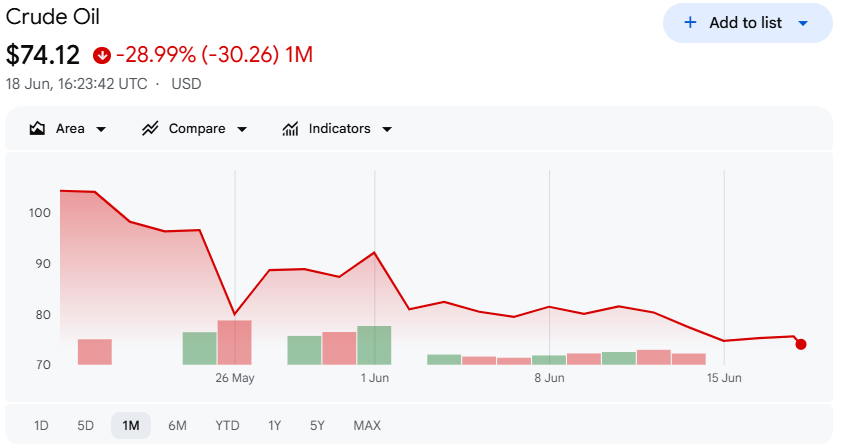
Source: Google finance as of Jun. 18, 2026.
Can BTC gain on the back of this positive geopolitical news? Yes, as long as the reduction in oil prices significantly allays the fears of high inflation and its associated higher interest rates. However, whether this plays out or not depends on the success of the (possibly fragile) ceasefire—and the view that new Kevin Warsh, the new Chair of the Federal Reserve of the United States, takes on interest rates.
Cryptocurrencies including BTC, ETH, XRP, SOL, BNB, and others are speculative and highly volatile assets subject to significant price movements. Even stablecoins, which are seemingly “safe,” may be risky if not adequately backed by real-world assets.
Investing in bitcoin and other crypto coins carries significant market, technological, and regulatory risks. Invest in crypto only if it aligns with your broader investment goals, time horizon, and risk profile, and always stay vigilant about crypto scams.
Share this article Share on Facebook Share on Twitter Share on Linkedin Share on Reddit Share on Email


Should you buy or rent? Our guide breaks down the cost of homeownership vs. renting.
Canadian-listed “.U” ETFs let investors put U.S. dollars to work without buying U.S.-domiciled funds, potentially offering advantages for tax...

Home sales in Canada are down but sale prices and listings are up find out what the latest numbers...

Run clubs, pickleball leagues, and hobby groups are changing how young professionals network. Here’s why making friends first can...

You may be surprised how much RRIF income increases your tax bill after age 71. Here are some ways...
With the Canadian dollar weakening, investors may be considering currency-hedged ETFs. But whether hedging makes sense depends on a...

David Chilton is retiring at 65 after four decades in personal finance. He shares why he’s stepping back and...

Moving away for school can bring sticker shock. Here’s how to plan for housing, food, transportation, and other expenses.

Setting financial boundaries might feel awkward in the moment, but learning when to say no is a money skill...

Many Canadians are entitled to compensation from a 2020 CRA class action settlement. Here is what you need to...
Articles like this are giving a worthless “asset” the credibility it doesn’t deserve. Crypto is worth 0. Period. The fact that it has a dollar value is because people believe it has value… because other people believe it has value. It’s the biggest self-delusion scheme I have seen in my life time, and is even worse than the Tulip Bulb bubble. It’ll all go to zero, and you can see all the non-existent patterns in the behavior you want until then.