


Canadians have no shortage of options when it comes to selecting a new credit card. Whether you’re looking at a Visa, Mastercard, or Amex from a fintech, big bank, or credit union, we’re here to help you sort through all your choices.
To make it easier to find the best credit card for you, we’ve broken the best credit cards down based on the financial goals and categories they best align with. Once you’ve decided what you’re looking for from a new credit card, check out our top picks and apply today.
Compare popular credit cards in Canada
The best credit card depends on how you plan to use the card and what you’re hoping to get from it. For instance, someone who’s looking to score a lot of Aeroplan points might look for the best travel card option, while a balance transfer credit card might be the best for a person trying to pay down debt.
Take a moment to determine what you’re looking for in a credit card: cash back, premium perks, savings opportunities, or credit building. Then, use our interactive tool or read through our list of the best cards to find the one that suits your needs.

Best credit cards in Canada to earn rewards
Let’s start by looking at credit cards that earn you various rewards, from all-around cash back to travel, gas, and groceries.
| Rewards category | Our top credit card pick | Why we love it | Annual fee |
|---|---|---|---|
| Cash back | Rogers Red World Elite Mastercard | * Earns 1.5% back on all Canadian purchases (2% if you’re a Rogers, Fido, or Shaw customer)* Earns 3% back on USD purchases | $0 |
| Travel | Scotiabank Gold American Express | * No foreign transaction fees* Includes robust travel insurance coverage | $120 (first year waived) |
| Rewards points | Scotiabank Gold American Express | * Earns up to 6 Scene+ points per $1* Flexible redemption options, including Scene+ Travel by Expedia | $120 (first year waived) |
| Aeroplan | TD Aeroplan Visa Infinite | * Reach Aeroplan Elite status faster* Enjoy free checked bags on Air Canada flights | $139 (first year waived) |
| Grocery | Scotia Momentum Visa Infinite + Card | * Earn 4% back on groceries* Earn 10% back on all purchases in the first 3 months (up to $2,000 in total purchases) | $120 (first year waived) |
| Gas | CIBC Dividend Visa Infinite | * Earn 4% back on gas and EV charging* Save up to 10 cents per litre at select gas stations with Journie Rewards | $120 (first year rebated) |
| Store | PC World Elite Mastercard | * Earns points at one of the largest retail networks in Canada* Earn 3% to 4.5% back in PC points at Shoppers and Loblaws banner stores on select purchases | $0 |
Best cash back card: Rogers Red World Elite Mastercard
The Rogers Red World Elite Mastercard is truly the best cash back credit card in Canada, offering a high earn rate of 1.5% on all purchases, which means there’s no need to worry about maximizing bonus categories. The accelerated rate of 3% on all U.S. purchases is enough to cover foreign transaction fees. What’s more, this no-fee option also provides valuable travel perks, including airport lounge access, emergency medical, and trip cancellation insurance.
Rogers Red World Elite Mastercard

Annual fee: $0
- 3% cash back on all U.S. dollar purchases
- 1.5% on all other purchases (2% for Rogers, Fido and Shaw customers)
Welcome offer: None at this time.
Card details
| Interest rates | 25.99% on purchases, 27.99% on cash advances, 27.99% on balance transfers |
| Income required | $80,000 per year |
| Credit score | 725 or higher |
Pros
- Solid rewards: Earn 1.5% on all purchases in Canada. As a Mastercard, this is one of the best cards to use at Costco, which doesn’t accept Visa or American Express.
- Rogers, Fido, and Shaw customers earn more: Customers get 2% cash back on all purchases (instead of the standard 1.5%). Plus, when they redeem cash back with Rogers, Fido, or Shaw, the rewards are worth 1.5 times more.
- U.S. shopping bonus: Earn 3% cash back on U.S. currency purchases, easily offsetting the standard 2.5% foreign transaction fee.
- No annual fee: This is uncommon for World Elite Mastercards in Canada.
- Flexible redemptions: Redeem rewards against purchases on your card for as little as $10.
Cons
- High income requirement: As a World Elite Mastercard, this card carries eligibility requirements that put it out of reach for some Canadians.
Best travel credit card in Canada: Scotiabank Gold American Express
The Scotiabank Gold American Express is the best travel credit card in Canada thanks to its impressive rewards program, comprehensive insurance package, and suite of travel perks, including no foreign transaction fees. The card includes a generous welcome bonus and allows you to redeem points for travel through Scene+ Travel, Powered by Expedia, or request statement credits to put towards travel purchased elsewhere.
Scotiabank Gold American Express

Annual fee: $120
- 6 points per $1 at Sobeys-affiliated stores
- 5 points per $1 on dining, entertainment and groceries
- 3 points per $1 on gas, transit and streaming
- 1 point per $1 on everything else
- Pay no FX fees on foreign purchases
Welcome offer: Earn up to $950 in welcome offers, first-year rewards and savings value, and up to 50,000 bonus Scene+ points. Offer ends November 1, 2026.
Card details
| Interest rates | 21.99% on purchases, 22.99% on cash advances, 22.99% on balance transfers |
| Income required | $12,000 per year |
| Credit score | 725 or higher |
| Point value | 1 Scene+ point = $0.01 when redeemed for travel, store purchases and food and drink at Cineplex and Scene partners |
Pros
- Straightforward redemptions: Redeem for travel purchases through Scene+ Travel, Powered by Expedia, in increments of 100 points (valued at $1). There are no complicated rules or exceptions to manage.
- Redeem points retroactively: Through the “apply points to travel” option, you can redeem your points for up to 12 months after you make a travel purchase.
- Generous insurance package: This card includes 12 types of insurance coverage, including emergency medical (including for those over 65), travel accident, hotel burglary, and more.
- No foreign transaction fees: Enjoy savings on foreign currency transactions when travelling or online shopping, since this card waives the usual 2.5% foreign transaction fee.
- Basic eligibility requirements: You will need an income of $12,000 per year to qualify, making it accessible to most Canadians.
Cons
- Fixed point redemption value: Although earning rates are high, points are always valued at 1 cent and cannot be transferred to airline frequent flyer programs.
- No free airport lounge passes: While the card offers a discount on Priority Pass memberships for airport lounge access, it doesn’t include any free lounge visits.
Best rewards points credit card: Scotiabank Gold American Express
Yes, we’re listing the Scotiabank Gold Amex twice. Not only is it the best travel card, but it’s also the best if you want to earn rewards points. The card starts you with plenty of Scene+ points as a welcome bonus. From then on, you’ll earn 6 points per $1 at Sobeys, Safeway, and Freshco; 5 points per $1 on groceries, entertainment, and dining; 3 points per $1 on gas, streaming, and transit; and 1 point per $1 spent on everything else (including foreign currency purchases).
Scotiabank Gold American Express
Annual fee: $120
- 6 points per $1 at Sobeys-affiliated stores
- 5 points per $1 on dining, entertainment and groceries
- 3 points per $1 on gas, transit and streaming
- 1 point per $1 on everything else
- Pay no FX fees on foreign purchases
Welcome offer: Earn up to $950 in welcome offers, first-year rewards and savings value, and up to 50,000 bonus Scene+ points. Offer ends November 1, 2026.
Card details
| Interest rates | 21.99% on purchases, 22.99% on cash advances, 22.99% on balance transfers |
| Income required | $12,000 per year |
| Credit score | 725 or higher |
| Point value | 1 Scene+ point = $0.01 when redeemed for travel, store purchases and food and drink at Cineplex and Scene partners |
Pros
- Variety of redemption options: You can redeem your points for high-value rewards, including movie tickets and concessions, dining at restaurants, shopping at Sobeys, travel, statement credits, Apple products, and merchandise.
- Redeem points retroactively: Through the “apply points to travel” option, you can redeem your points for up to 12 months after you make a travel purchase.
- Basic eligibility requirements: You will need an income of $12,000 per year to qualify, making it accessible to most Canadians.
Cons
- Fixed point redemption value: Although earning rates are high, points are always valued at $0.01 and cannot be transferred to airline frequent flyer programs, unlike some other cards.
- No free airport lounge access: While the card offers a discount on Priority Pass memberships for airport lounge access, it doesn’t include any free lounge visits.
Best Aeroplan card: TD Aeroplan Visa Infinite
If you frequently fly with Air Canada, consider the TD Aeroplan Visa Infinite—our pick for the best Aeroplan credit card in Canada. It comes with easy redemptions and extras like a $100 Nexus fee rebate every four years.
TD Aeroplan Visa Infinite Card
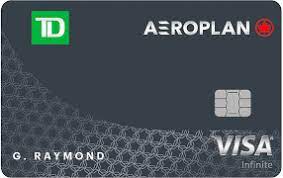
Annual fee: $139 (waived first year)
- 1.5 Aeroplan points per $1 on gas, EV charging, groceries and purchases
- 1.5 Aeroplan points per $1 on purchases made directly through Air Canada (including vacation packages)
- 1 point per $1 on all other purchases
Welcome offer: Up to $1,550 in value, including up to 50,000 Aeroplan points, could be yours. Plus, receive an Annual Fee rebate for the first year. Conditions apply.
Card details
| Interest rates | 21.99% on purchases, 22.99% on cash advances (21.99% in Quebec), 22.99% on balance transfers (21.99% in Quebec) |
| Income required | Personal income of $60,000 or household income of $100,000 |
| Credit score | 680 or higher (recommended) |
| Point value | Aeroplan points are worth $0.02 on average |
Pros
- Free checked bags for up to nine people: Cardholders and up to eight companions travelling on the same reservation get their first checked bag free on Air Canada flights.
- Flexible redemptions: Redeem your points for Air Canada flights or on a dozen Star Alliance partners like Lufthansa and United.
- NEXUS fee rebate: Receive a partial reimbursement of your NEXUS fee every 48 months, making it easier to travel over the Canada-U.S. border.
- Competitive insurance package: This card includes emergency medical travel coverage for up to 21 days—longer than many comparable cards—or up to four days for Canadians 65 and older.
- Earn more at Starbucks: Link your eligible Card to earn more Starbucks Stars at participating Starbucks stores. Conditions apply.
Cons
- High annual fee: This card charges a slightly higher fee than some other cards in its category at $139 per year.
Best grocery credit card: Scotia Momentum Visa Infinite + Card
With the Scotia Momentum Visa Infinite + Card, you’ll earn a healthy 4% on groceries and recurring bill payments, while transportation costs (including Uber) and gas earn at 2%. You’ll also earn 1% back on all other purchases. To get you started, this Scotia card gives you 10% cash back for the first 3 months (up to $2,000 in spending).
Note: Earn rate on rent and tax payments will change from accelerated recurring bill payment earn rate to the regular purchase earn rate effective October 22, 2026.
Scotia Momentum Visa Infinite + Card
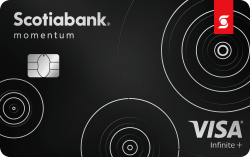
Annual fee: $120
- 4% cash back on groceries, recurring bill payments and subscription services
- 2% on gas and public transit
- 2% cash back on food delivery
- 1% on everything else
Welcome offer: Earn 15% Cash Back on all purchases for the first 3 months (up to $2,000 in total purchases).1 Plus, get a 0% introductory interest rate on balance transfers for the first 12 months (2% fee per cash advance, 22.99% after that). And, no annual fee in the first year, including on additional cards. Offer ends November 1, 2026.
Card details
| Interest rates | 20.99% on purchases, 22.99% on cash advances, 22.99% on balance transfers |
| Income required | New Income Requirement: minimum income of $60,000 – $80,000 or more per year, a minimum household income of $100,000 – $150,000 or more, or a minimum of $250,000 – $300,000 or more assets under management. |
| Credit score | 725 or higher |
Pros
- Well-rounded insurance package: Enjoy almost a dozen types of insurance coverage, including trip delay, baggage coverage, rental car coverage, and more.
- Visa Infinite benefits: Get access to the Visa Luxury Hotel Collection, Visa Dining, and Wine tasting, all of which provide deals on exclusive accommodations and experiences.
- Annual fee waiver: Sign up for the Scotiabank Ultimate Banking Package and Scotia will waive this card’s annual fee (a $120 value).
Cons
- High income requirements: You’ll need either $60,000 personal or $100,000 household annual income to qualify.
- Rewards are only available as statement credits: This card doesn’t allow you to choose how to redeem points. Instead, a cash back statement is issued to cardholders once per year.
Best gas credit card: CIBC Dividend Visa Infinite
The CIBC Dividend Visa Infinite offers unbeatable rewards for everyday spending, with up to 4% cash back on gas, EV charging, and groceries. With an additional 2% cash back on dining, transit, and recurring bills, plus 1% on everything else, this card delivers consistent rewards across categories. Plus, save up to 10 cents per litre at select gas stations with Journie Rewards. It’s the perfect card for anyone looking to save at the pump.
CIBC Dividend Visa Infinite
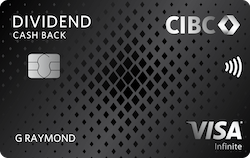
Annual fee: $120 (rebated first year)
- 4% cash back on eligible gas, EV charging and grocery purchases
- 2% on dining, daily transit and recurring payments
- 1% on everything else
Welcome offer: Join and earn over $400 in value including a first year annual fee rebate.
Card details
| Interest rates | 21.99% on purchases, 22.99% on cash advances, 22.99% on balance transfers |
| Income required | Personal income of $60,000 or household income of $100,000 |
| Credit score | 725 or higher |
Pros
- High earning potential: This card gives you the highest earn rate for gas in Canada and one of the highest for groceries.
- Gas savings: Link your card with Journie Rewards and save up to 10 cents per litre at Pioneer, Fas Gas, Ultramar, and Chevron stations.
- Easy redemption: Redeem cash back anytime (for a minimum of $10) through CIBC’s online and mobile banking.
- Get 50% off Disney+ for 6 months: Use an eligible CIBC credit card to pay for your Disney+ Standard with Ads subscription, and automatically receive $4.50 each month in statement credits.
Cons
- High eligibility requirements: Qualifying for this card may be more challenging with a minimum income threshold of $60,000 per year for individuals and $100,000 for household earnings.
- Earning cap: Most cards have specific limits for each category, but this card caps higher bonus rates at $80,000 net spending, which may be limiting for large households.
- Limited insurance: The card offers limited insurance options for a $120 annual fee.
Best store credit card: PC World Elite Mastercard
The PC World Elite Mastercard earns you PC Optimum points faster when you shop at any of the Loblaw banner stores (Loblaws, No Frills, Superstore, Fortinos, etc.), Shoppers Drug Mart, and when you fill up at Esso and Mobil gas stations.
PC Insiders World Elite Mastercard

Annual fee: $120
- Up to 70 points per $1 on gas at at Esso & Mobil
- 50 points per $1 spent at Shoppers Drug Mart and Pharmaprix
- 40 points per $1 at Loblaw banner stores
- 40 points per $1 on Joe Fresh apparel
- 10 points per $1 on all other purchases
Welcome offer: earn a welcome offer* of 300,000 PC Optimum™ points with the NEW PC® Insiders World Elite® Mastercard®. Conditions apply. Offer ends December 31st, 2024.
Card details
| Interest rates | 20.99% on purchases, 22.97% on cash advances, % on balance transfers |
| Income required | Personal income of $80,000 per year or household income of $150,000 per year |
| Credit score | 660 or higher |
| Point value | 1 PC Optimum point is worth $0.001 (redeem 10,000 points for $10) |
Pros
- Earn more at Loblaw banner stores: Rack up the equivalent of 4.5% cash back in PC Optimum points at Shoppers Drug Mart and 3% on groceries from Loblaws banner stores.
- PC Optimum points are easy to understand: 10,000 points are equivalent to $10 redeemable in merchandise or a free car wash, or you can trade 4,000 points for 10 cents off per litre at Esso stations.
- Includes basic insurance: The card comes with travel emergency medical insurance and rental car insurance.
- Double up on points: You can stack points on points by using your credit card to pay for personalized offers from the PC Optimum app, in-store points offers, and/or flyers.
Cons
- No free gas reward: Although you can earn points at Esso and Mobil gas stations, you can’t redeem points for free gas.
- High income requirement: The minimum annual income requirement of $80,000 for an individual (or $150,000 as a household) may make the card inaccessible to some Canadians.
- Minimum spending requirement: You must spend a minimum of $15,000 annually to maintain this account. If you don’t, you will automatically be considered for a different PC card.
Best credit cards in Canada for perks and benefits
If you’re looking for a specific credit card benefit or feature, check out some of the perks and benefits that make these cards shine.
| Perks | Our top credit card pick | Why we love it | Annual fee |
|---|---|---|---|
| No foreign transaction fees | Scotiabank Gold American Express | * No foreign exchange fee saves you 2.5% on foreign purchases* Includes generous welcome bonus | $120 (first year waived) |
| Airport lounge access | Scotiabank Passport Visa Infinite + Card | * Comes with free Priority Pass membership* Includes six free airport lounge passes every year | $150 |
| Travel insurance | National Bank World Elite Mastercard | * Offers a robust insurance package that includes almost a dozen types of coverage* Insurance coverage limits are higher than with other credit cards | $150 |
| Car rental insurance | BMO CashBack World Elite Mastercard | * Comes with $200,000 of rental car accident coverage* Includes rental car theft, damage, and personal effects coverage | $139 (first year waived) |
| Mobile device insurance | RBC Avion Visa Infinite | * Gives $1,500 in mobile device insurance* Comes with almost a dozen additional types of insurance coverage | $120 |
| Free roadside assistance | TD Cash Back Visa Infinite Card | * Includes emergency roadside services through Deluxe TD Auto Club Membership* Services include towing, emergency tire changes, and more | $139 (first year waived) |
Best no-foreign transaction fee card: Scotiabank Gold American Express
With an impressive earn rate—especially on groceries, dining, and entertainment—plus a comprehensive insurance coverage package, the Scotiabank Gold American Express is not only the best no foreign transaction fee credit card, but also one of the best overall travel credit cards in Canada. The card earns Scene+ points, which you can redeem for travel, movie tickets or concessions, groceries, gift cards, statement credits, and more.
Scotiabank Gold American Express
Annual fee: $120
- 6 points per $1 at Sobeys-affiliated stores
- 5 points per $1 on dining, entertainment and groceries
- 3 points per $1 on gas, transit and streaming
- 1 point per $1 on everything else
- Pay no FX fees on foreign purchases
Welcome offer: Earn up to $950 in welcome offers, first-year rewards and savings value, and up to 50,000 bonus Scene+ points. Offer ends November 1, 2026.
Card details
| Interest rates | 21.99% on purchases, 22.99% on cash advances, 22.99% on balance transfers |
| Income required | $12,000 per year |
| Credit score | 725 or higher |
| Point value | 1 Scene+ point = $0.01 when redeemed for travel, store purchases and food and drink at Cineplex and Scene partners |
Pros
- Excellent rewards: Earn up to 6 points on groceries and 5 points for every $1 spent on dining, food delivery, and entertainment—among the best reward rates for these categories. You’ll also earn 3 points per $1 on gas, transit, and streaming services.
- Long travel redemption window: Through the “apply points to travel” option, you can redeem your points retroactively for up to 12 months after you make a travel purchase.
- Comprehensive insurance benefits: The card offers robust travel insurance coverage, including $1 million in medical travel insurance valid for up to 25 days.
- Low income requirements: You only need an income of $12,000 per year to qualify for the card, making it accessible to most Canadians, although you’ll still need a good credit score.
Cons
- No free lounge passes: While the card offers a discount on Priority Pass memberships for airport lounge access, it doesn’t include any free visits.
- Fewer points on foreign purchases: Purchases in a foreign currency earn at the base rate of 1 point per $1 spent.
Best airport lounge access card: Scotiabank Passport Visa Infinite + Card
With six complimentary airport lounge visits a year as part of the Visa Airport Companion program, the Scotiabank Passport Visa Infinite + Card offers the most free visits among credit cards in a comparable fee range. With Visa Airport Companion membership, you’ll have access to over 1,200 airport lounges around the world. Plus, the card provides additional travel perks like no foreign transaction fees and a solid travel insurance package.
Scotiabank Passport Visa Infinite + Card

Annual fee: $150
- 3 Scene+ points per $1 spent at Sobeys stores
- 2 points per $1 on groceries, dining, entertainment and transit
- 1 point per $1 on all other eligible purchases
Welcome offer: Earn up to $1,500 in first year welcome offers, rewards and savings, including up to 60,000 bonus Scene+ points. Offer ends August 3, 2026.
Card details
| Interest rates | 20.99% on purchases, 22.99% on cash advances, 22.99% on balance transfers |
| Income required | You have a minimum income of $60,000 – $80,000 or more per year, a minimum household income of $100,000 – $150,000 or more, or a minimum of $250,000 – $300,000 or more assets under management. |
| Credit score | 725 or higher |
| Point value | 1 Scene+ point = $0.01 when redeemed for travel on any airline or hotel (including Airbnbs). |
Pros
- Airport lounge access: This card comes with complimentary Visa Airport Companion membership and six lounge passes per year, the most free visits of any travel credit card in a similar fee range.
- No FX fees: You won’t be charged a foreign transaction fee on purchases made in international currencies.
- Good travel insurance: Get emergency medical insurance for up to 25 days (for those under 65 years of age), plus trip cancellation, flight delay, lost baggage, rental car insurance, and more.
Cons
- Limited earning potential: The points earned in categories, such as dining and entertainment, are valued at less than what you might get from other cards.
- Fixed point value: Travel points are always valued at one cent each, and unlike some other credit cards, you can’t transfer points to airline loyalty programs.
- High annual fee: The $150 annual fee is steeper than that of some similar credit cards.
Best travel insurance credit card: National Bank World Elite Mastercard
Not only does the National Bank World Elite Mastercard offer a wide range of insurance—from emergency medical to trip cancellation, baggage delay, and car rental insurance—but the actual coverage amounts are impressive. Most notable is the extended duration of emergency medical coverage, including for seniors aged 65 and older. Although the card doesn’t come with a welcome bonus, you will enjoy an annual $150 travel credit.
National Bank World Elite Mastercard
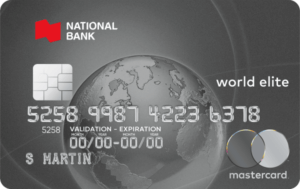
- Annual fee: $150
- Interest rates: 20.99% on purchases, 22.49% balance transfers and cash advances
- Earn rate: Up to 5 points per $1 on grocery and restaurant purchases; 2 points per $1 on gas, EV charges, recurring bill payments and travel booked through À La Carte Rewards; and 1 point per $1 on all other purchases.
- Welcome offer: n/a
- Annual income requirement: Personal income of $80,000 or household income of $150,000
Pros
- Length of emergency medical coverage: Get $5 million in emergency medical coverage for trips of up to 60 days, which is three times longer than many other top-tier travel insurance cards. Canadians ages 65 to 75 are covered for up to 15 days (typically, coverage is for 3 to 5 days).
- Coverage for travel inconveniences: Comes with above-average trip cancellation coverage of $2,500 and trip interruption coverage of $5,000.
- Annual fee: While higher than the average cost of $120, the $150 annual fee is much lower than most premium cards with comparable or lesser insurance packages.
- Airport lounge access: Cardholders have unlimited access to the National Bank Lounge at the Pierre Elliott Trudeau Airport in Montreal in addition to a Mastercard Travel Pass membership.
Cons
- No travel accident coverage: You’re not covered for injuries that occur while travelling on a common carrier, such as an airplane or train.
- High income requirements: As with other World Elite Mastercards, the eligibility requirements may be difficult to meet: a gross annual income of $80,000 for individuals or $150,000 for households, $400,000 in investable assets, or an annual spend of $25,000 on the card itself.
- No welcome bonus: For a card that charges a premium fee, it’s surprising that you don’t earn even a little welcome bonus.
Best car rental insurance card: BMO CashBack World Elite Mastercard
The BMO CashBack World Elite Mastercard has a solid variety of extra-earn categories that are targeted to where Canadians spend the most, like groceries, transit, and gas. It’s also one of the few cards that offers free roadside assistance. However, this card really shines when it comes to rental car insurance coverage, offering a high limit of $200,000 with a rental car accident policy. You’ll also get $1,000 in rental car personal effects coverage.
BMO CashBack World Elite Mastercard
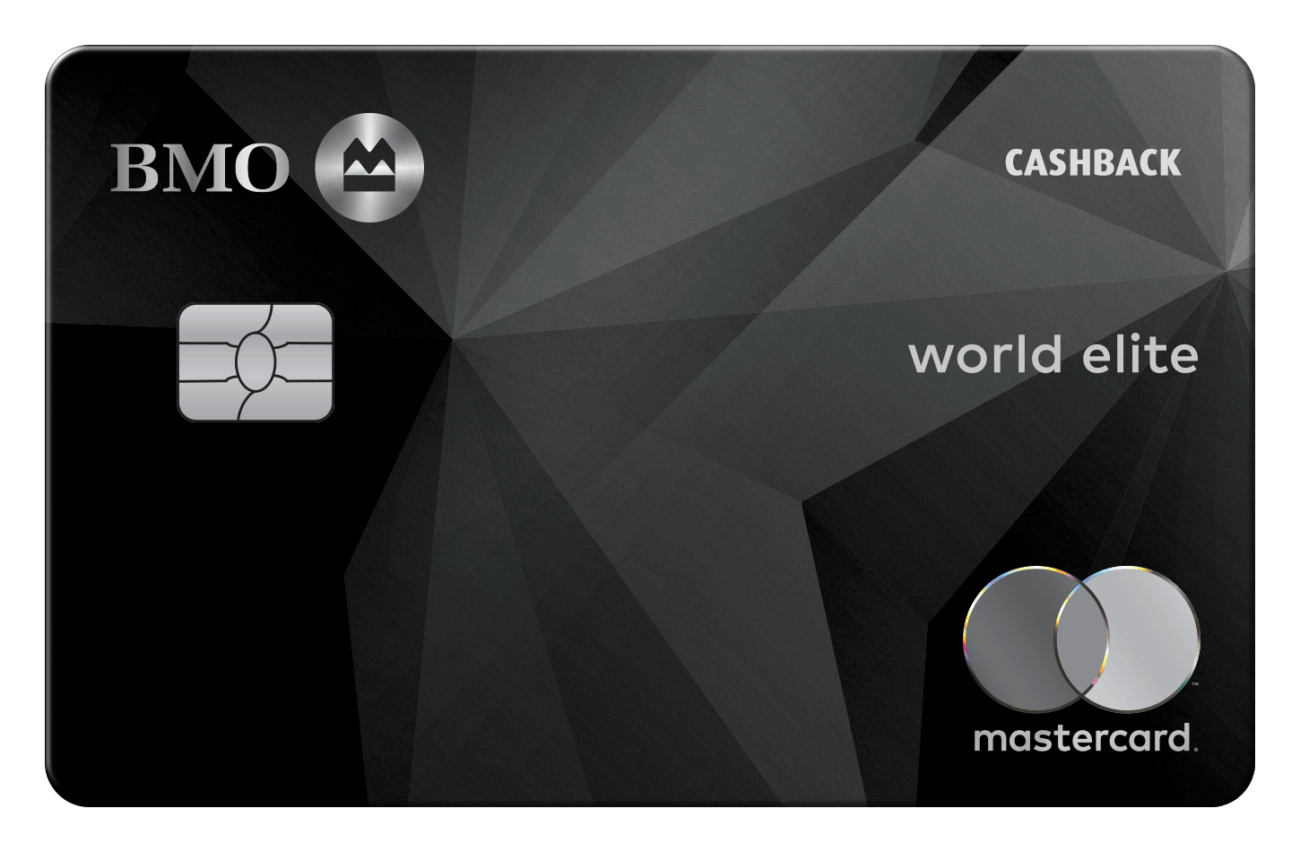
Annual fee: $139 (waived first year)
- 5% cash back on groceries
- 4% back on transit
- 3% back on gas and electric vehicle charging
- 2% on recurring bill payments
- 1% back on everything else
Welcome offer: Get up to $650 in value and the annual fees waived in the first year. Plus, get a 0% introductory interest rate on Balance transfers for 12 months with a 2% transfer fee.
Card details
| Interest rates | 21.99% on purchases, 23.99% on cash advances, 23.99% on balance transfers (21.99% in Quebec) |
| Income required | Personal income of $80,000 or household income of $150,000 |
| Credit score | 680+ |
Pros
- Boosted cash-back categories: Groceries and transit are some of this card’s highest earning categories, but you’ll also earn 3% back on gas (up to a $300 monthly spending limit).
- Free roadside assistance: Simply call if you need a battery jump, delivery of fuel, tow to a mechanic, or assistance with a flat tire.
Cons
- Mastercard Travel Pass: While this card gives you airport lounge membership by DragonPass, it doesn’t include any free lounge visits. You must pay a fee of USD$32 per visit.
- High income requirements: The income requirement is high at a minimum of $80,000 per year for individuals and $150,000 for households.
Best mobile device insurance card: RBC Avion Visa Infinite
The RBC Avion Visa Infinite is a premium travel credit card that has a flexible rewards program and exclusive benefits. More importantly, it has the highest coverage limit for mobile device insurance of any Canadian credit card. You’ll enjoy $1,500 in mobile device insurance coverage (compared to the typical $500–$1,000 limit).
RBC Avion Visa Infinite
Annual fee: $120
- 1.25 Avion points per $1 spent on travel (including flights, hotels, taxis and public transit)
- 1 point per $1 on all other purchases
Welcome offer: Get up to 70,000 Avion points a travel value of up to $1,500. Apply by November 25, 2026.
Card details
| Interest rates | 20.99% on purchases, 22.99% on cash advances and on balance transfers (21.99% for Quebec residents) |
| Income required | $60,000 per year |
| Credit score | None specified |
| Point value | 1 RBC Avion point = Up to $0.023 when redeemed for travel using RBC’s Air Travel Redemption Schedule. |
Pros
- Flexible rewards program: RBC Avion points can be worth as much as 2.3 cents each when redeemed for travel, which is a high value among travel rewards cards. You can redeem points for travel through RBC, transfer points, or select reimbursement.
- Generous insurance package: This card includes impressive travel insurance coverage, including trip cancellation and interruption, and emergency medical.
- Strong welcome bonuses: While they vary throughout the year, you’ll typically start your rewards off with a tidy sum of Avion points after meeting certain requirements.
Cons
- Lacklustre competitive: The highest earn rate is 1.25%, which is relatively low for a premium card; other premium cards offer significantly higher earn rates.
- High income requirements: The personal annual income requirement of $60,000 (or household income of $100,000) may be too high for some applicants.
Best roadside assistance card: TD Cash Back Visa Infinite Card
Cardholders are automatically enrolled as Deluxe members in the TD Auto Club, which entitles you to 24/7 complimentary roadside assistance services. This coverage handles roadside emergencies like dead batteries, flat tires, or breakdowns. As a Deluxe member, you’ll have access to a tow to the nearest service centre (up to 200 kilometres), emergency transportation, and even financial reimbursement for food and rest expenses up to $200 in case you’re stranded due to a vehicle-related issue. Similar assistance packages typically cost between $69 and $100 on a stand-alone basis.
TD Cash Back Visa Infinite Card
Annual fee: $139 (rebated first year)
- 3% cash back on groceries, gas, EV charging, public transit, recurring bill payments, streaming and digital gaming
- 1% on all other purchases
Welcome offer: Earn up to $600 in total value, including an Annual Fee rebate for the first year. Conditions apply.
Card details
| Interest rates | 21.99% on purchases, 22.99% on cash advances (21.99% in Quebec), 22.99% on balance transfers |
| Income required | Personal income of $60,000 or household income of $100,000 |
| Credit score | 680 or higher (recommended) |
Pros
- High everyday earn rate: Rack up three times the cash back on groceries, gas, EV charging, digital gaming, and recurring bills.
- Roadside assistance: The value of this card’s free roadside assistance more than pays for the card’s annual fee.
- Generous welcome bonus: Get 10% back for the first three months on the enhanced earnings category (up to $3,500 in spending).
Cons
- Standard insurance: For a premium card, you might expect more robust insurance coverage or higher coverage limits.
- High income requirements: The minimum income requirement of $60,000 personal or $100,000 household income might be too high for some Canadians to qualify.
Best credit cards in Canada to save on interest
If you’re looking for a new credit card with the expectation that you’ll carry a balance between months, it’s essential to find a card with the lowest interest rate possible.
| How to save | Our top credit card pick | Why we love it | Annual fee |
|---|---|---|---|
| Low interest rates | Desjardins Flexi Visa | * Low interest rate of 10.90% on purchases* Low cash advance rate of 12.90% | $0 |
| Balance transfer | MBNA True Line Mastercard | * Low interest rate of 17.99% on balance transfers* Pay only 12.99% on purchases | $0 |
Best low interest credit card: Desjardins Flexi Visa
If you know you’ll be carrying a credit card balance from month to month, you want a card with a low interest rate. Fortunately, the Flexi Visa from Desjardins Credit Union offers a low standard interest rate of 10.90% on purchases and 12.90% on cash advances—the lowest in Canada for a no-fee credit card. Plus, the card includes some travel insurance, select rental car discounts, and mobile device insurance—perks typically only found with annual-fee cards.
Desjardins Flexi Visa
Annual fee: $0
Rewards: Does not offer rewards.
Welcome offer: None at this time.
Card details
| Interest rates | 10.90% on purchases and 12.90% on cash advances |
| Income required | Not specified |
| Credit score | Not specified |
Pros
- Lowest interest rate available: The Flexi Visa has the lowest purchase APR of any no-fee card in Canada.
- Travel insurance included: This card comes with emergency medical, trip cancellation, and baggage coverage for up to three days—suitable for a weekend trip. Plus, the emergency medical coverage applies to travellers age 75 and under, whereas coverage stops at 65 with some cards.
- No annual fee or income requirements: You don’t have to pay anything for the privilege of using this card—but be aware that you still have to meet credit score requirements.
Cons
- Interest rates may increase: If you fail to make your minimum payment on time, the interest rate for both purchases and cash advances goes up to 19.99%.
- No rewards: You won’t earn rewards on your purchases, but if you know you’ll be carrying a balance, the lower interest rates are the way you’ll save money with this card.
- No balance transfer promotion: If your goal is to pay off a current credit card balance fast, consider a card with a balance transfer promotion instead. The Flexi Visa doesn’t charge a balance transfer fee, however, which is a plus for those who decide to transfer anyway.
- Limited in-person support: Desjardins only offers brick-and-mortar branches in Ontario and Quebec.
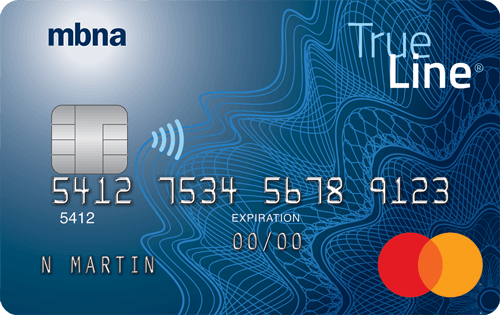
Best balance transfer credit card: MBNA True Line Mastercard
For balance transfers, our pick is the MBNA True Line Mastercard. It provides a lot of breathing room for paying down debt: 12 months of 0% interest on balance transfers completed within 90 days of opening your account. There is a small 3% fee when you make the transfer, but you’ll have a full year to pay down debt.
MBNA True Line Mastercard
Annual fee: $0
Balance transfer offer: Receive a 0% interest rate for 12 months on balance transfers completed within 90 days. (Offer not available for residents of Quebec.)
Card details
| Interest rates | 12.99% on purchases, 24.99% on cash advances, 17.99% on balance transfers |
| Income required | None specified |
| Credit score | 660 or higher |
Pros
- Best promotional balance transfer offer: The welcome offer gives you a full year interest-free to get on top of your debt.
- Low regular purchase interest rate: This rate is fixed and won’t change regardless of missed payments or changes in the prime rate.
- No annual fee: You don’t have to pay an annual fee to use the card. This means more money to put towards your credit card balance.
Cons
- Balance transfer fee: The transfer fee of 3% (with a minimum fee of $7.50) is higher than comparable cards with a transfer fee of 1% or 2%.
- Not available in Quebec: Residents of the province aren’t eligible for this card.
Best credit cards in Canada to establish or rebuild credit
For some, credit cards are the key to rewards and lifestyle perks. For others, a credit card is a tool to build, establish, or rebuild credit. If that’s you, consider the options below.
| Our top credit card pick | Why we love it | Annual fee |
|---|---|---|
| Secured Neo Mastercard | * Minimum deposit of $50* Earns an average of 5% back with Neo retail partners | $9.99 monthly |
| Simplii Financial Cash Back Visa | * Easier to qualify for and earns rewards on everyday purchases* Gives cash back on global money transfers | $0 |
Best secured credit card: Secured Neo Mastercard
Secured credit cards may seem lacklustre compared to premium unsecured cards that offer things like rewards and insurance. However, the Secured Neo Mastercard provides an opportunity to earn cash back rewards—a rare perk for a secured card. Additionally, the minimum deposit requirement is only $50, making it highly accessible to many Canadians who would otherwise be unable to access credit.
Secured Neo Mastercard
Annual fee: $9.99 monthly
Rewards: Up to 15% back at over 10,000 Neo partners across Canada.
Welcome offer: none at this time.
Card details
| Interest rates | 19.99% to 29.99% on purchases (19.99% to 24.99% for Quebec residents) and 22.99% to 31.99% on cash advances (22.99% to 25.99% for Quebec residents) |
| Income required | None |
| Credit score | None |
Pros
- Cash back on purchases: You can earn cash back on purchases made at Neo’s partner businesses.
- Low deposit requirement: With a minimum deposit of just $50, this card is accessible to most people, whereas many other secured cards require a deposit of $500 or more.
- Customizable rewards: For a monthly fee, you can subscribe to Neo’s Perks program, which offers extra rewards on spending and additional benefits, including airport lounge access.
- Boosted cashback: Up to 15% boosted cashback at thousands of partners across Canada.
- Gift card offer: After approval, if you qualify for the offer, you’ll receive a $50 gift card to Indigo, SkipTheDishes or a Virtual Prepaid Mastercard.
Cons
- Annual fee: If you’re looking for a card to establish or rebuild credit, you may not want to add a $60 annual credit card fee to your budget.
- Potentially high interest rates: Based on your credit profile, your interest rate may be as high as 29.99% on purchases and 31.99% on cash advances, which is steeper than the rates of other secured cards.
- Limited cash back potential: There is a cap on how much cash back you can earn, which may not be ideal for heavy spenders.
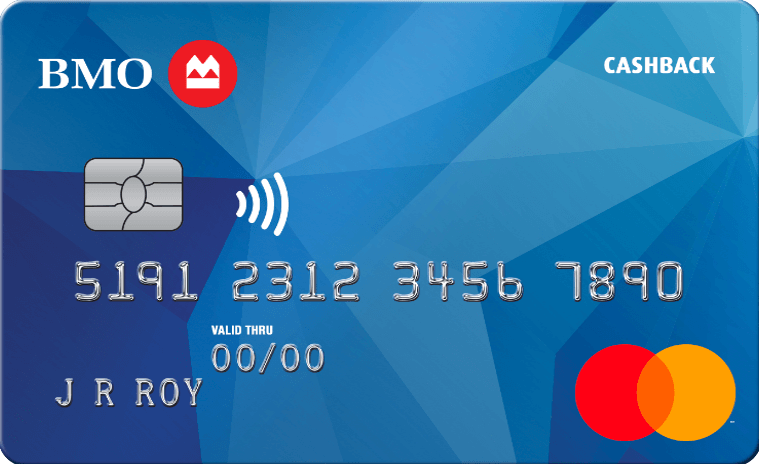
Best student credit card: BMO CashBack Mastercard
The BMO CashBack Mastercard is a top choice for students looking for easy cash-back earnings. Combining no annual fee with an impressive 3% cash back rate on grocery purchases, this card offers students a chance to earn cash rewards in a high-spend category.
BMO CashBack Mastercard
Annual fee: $0
- 3% cash back on groceries (on the first $500 per month)
- 1% on recurring bills
- 0.5% on everything else
Welcome offer: Get up to 5% cash back in your first 3 months and a 0.99% introductory interest rate on Balance Transfers for 9 months with a 2% transfer fee.
Card details
| Interest rates | 21.99% on purchases, 23.99% on cash advances, 23.99% on balance transfers |
| Income required | n/a |
| Credit score | None specified |
Pros
- High grocery earn rate: This BMO card gives the highest cash back rate for groceries among no-fee credit cards in Canada.
- Variety of redemption options: Redeem your cash (starting with as little as $1) whenever you wish, and have it applied as a statement credit, added to your BMO InvestorLine account, or deposited into your BMO chequing or savings account.
Cons
- Low monthly cap: This card only allows you to earn increased rewards on spending of $500 on groceries and recurring bills per month.
- Many retailers don’t qualify as grocery stores: Be aware that if you love stopping in at a bakery, coffee shop, or convenience store to grab a quick bite, these aren’t coded as grocery stores, so you won’t earn boosted rewards.
- Low base earn rate: If you’ve maxed out your groceries and recurring bills spending or are making other purchases, you’ll only earn 0.5% back.
Best newcomer credit card: Simplii Financial Cash Back Visa
The Simplii Financial Cash Back Visa is ideal for newcomers to Canada, allowing you to apply without a Canadian credit history through the New to Canada Banking Program. It offers 4% cash back on dining and 1.5% on essential purchases, such as groceries and gas. With no annual fee and a low income requirement, this card is accessible to many new arrivals seeking to build credit while earning rewards.
Simplii Financial Cash Back Visa
Annual fee: No annual fee
- 4% cash back on dining at restaurants, bars and coffee shops
- 1.5% back on gas, groceries, drugstores and recurring bills
- 0.5% on all other purchases
Welcome offer: Earn cash back on essentials with a Simplii Cash Back Visa Card! Earn up to $100 cash back in your first 3 months when you spend up to $500 spending on eligible gas, grocery, and drugstore purchases, and pre-authorized payments.†
Card details
| Interest rates | 20.99% on purchases, 22.99% on cash advances, 22.99% on balance transfers |
| Income required | $15,000 per year |
| Credit score | 660 or higher |
Pros
- No credit history required: Apply without a Canadian credit file through the Simplii New to Canada Banking Program. Apply for the program up to one year before arriving in Canada or up to five years after arriving.
- High earn rate on dining: Earn 4% at restaurants, bars, and coffee shops—almost double what similar no-fee cash back cards offer.
- Rewards on global money transfers: Get cash back on international transfers, with no transaction fees or interest charges if the balance is paid by the due date.
- Low income requirement: This card is accessible to most people as long as you have $15,000 in personal or household income.
Cons
- Simplii bank account required: To get this card, you’ll need a Simplii Financial account—an unusual requirement for a credit card.
- Annual redemption: Cash back is only redeemable as a statement credit once a year in December.
- Earning caps: The 4% cash back on dining is limited to the first $5,000 spent annually, and the 1.5% rate on other categories is capped at $15,000 in annual spending.
To select the best cards out of all your options in Canada, we evaluated several key factors that are important when using a credit card. First, we considered the return on spending, annual fees, and interest rates. We also looked at financial goals like saving on balance transfers, establishing credit, or travelling abroad. The addition of links from affiliate partners has no bearing on the results in this ranking. Read more about the MoneySense selection process and about how MoneySense makes money.
Reddit reviews: Which credit cards do Canadians love?
Reading through our list of best credit cards can be a good starting point in choosing a new credit card, but it also helps to get recommendations from real cardholders. We turned to Reddit to see which cards people are loving right now.
As for the best no-fee credit card, these cardholders agreed with our favourite card:


If you’ve ever checked Reddit threads for credit card recommendations, you’ll often see the American Express Cobalt pop up. However, as this user pointed out, the Scotiabank Gold Amex (our pick for rewards points) is actually a better option:

Ultimately, the best credit card for you depends on your spending habits and what you want the credit card to deliver.
How credit cards work
When you use a credit card in Canada, you’re essentially taking out a short-term loan with a balance that comes due every month. As you pay off your balance, the credit available to you the following month starts to go back up to the maximum credit limit on your card.
There are many ways you can use a credit card in Canada and internationally. For example, you can use a credit card to pay for goods and services, transfer existing credit card debt, or get a cash advance. As useful as these are, it’s important to understand responsible credit card use, which can keep your credit score in great shape so you qualify for better loans and interest rates in the future.
How does credit card interest work?
When you read your card’s terms and interest rates, you’ll see the interest expressed as an annual percentage rate (APR). Though APRs are expressed in annual terms, credit card interest is calculated daily and charged monthly. (The APR represents the total cost of borrowing money for a year.) You can figure out your daily interest rate by dividing your APR by 365—or 366 during a leap year.
If you keep a credit card balance from month to month, your purchases will be charged interest every day, which can really add up. Let’s take a look at an example using a card with a 19.99% APR:
- Your daily rate is 0.0548%
- A $1,000 balance would be charged $0.54 in interest charges in a single day
- This interest compounds daily—the next day (assuming you don’t make any additional purchases), you’d be charged interest on a total of $1,000.54, and so on
- As you can see, it’s best to pay down your debt as quickly as possible to avoid taking on ballooning interest fees.
Get free MoneySense financial tips, news & advice in your inbox.
Pros and cons of credit cards
When used responsibly, credit cards can be a key component in a healthy financial toolkit. However, if you struggle to stay on top of payments or within your credit limit, credit cards may not be worth it.
Pros
- Credit cards have wide acceptance and are easy to use. Whether you’re shopping online or in person, most merchants accept credit cards, which also means you don’t have to carry cash.
- You can earn rewards for everyday purchases. Depending on the credit card, you might earn miles towards travel rewards or points that you can redeem for cash back, merchandise, or gift cards.
- Responsible credit card use builds your credit score. Paying your credit card in full and on time every month does wonders for your credit score, which can help you score low interest rates on loan products down the road.
Cons
- You’ll damage your score if you miss payments. If you can’t pay off your card in full, you should at least make the minimum payment or your credit score will drop.
- It’s easy to spend more money than you have. Credit cards make it almost too easy to buy things, so you might find yourself with a bigger bill than you expected, especially if you carry a balance and are charged interest.
- You’ll be charged fees if you carry a balance. You might find it harder to pay off the charges to your card once interest is added. Plus, you might have to pay an annual fee to use the card and you may be hit with overlimit fees if you charge over your credit limit.
How to choose the right credit card for you
When Canadians shop around for a new credit card, they typically have one of four goals in mind: earn rewards, access perks, save on interest, or establish or rebuild credit.
Before you apply for a card, take a moment to think about what you want to get out of the card and what you plan to use the card for. Asking yourself the following questions can narrow your credit card choices:
- Do you want a credit card that offers rewards? These give cash back or travel points and are most suitable for Canadians who frequently use credit cards but don’t usually carry a balance.
- Would you rather earn points or cash back? A points card is best for those who travel often and see value in rewards for flights, hotels or other travel perks. A cash back card is typically more straightforward, offering a percentage of your spending on the card back as cash, which can be redeemed for credit or deposited into your bank account.
- Are you willing to pay for a premium credit card? Premium cards often have high annual fees and income requirements, but they tend to have more benefits, higher earn rates, and more distinctive perks than no-fee or conventional cards.
- Are you looking for a credit card with a specific perk? For instance, if you travel abroad, you might want a card that charges no foreign transaction fees or includes great travel insurance. Other potential perks include airport lounge access; priority boarding and free checked bags on flights; dining and travel credits; concierge services; and exclusive access to concerts, presale tickets, private experiences, and more.
- Do you plan on keeping a credit card balance? Be honest when answering this one. If you fully expect to have a balance, you’ll want to prioritize a low-interest card so you don’t pay more interest than you need to.
- Are you planning on transferring credit card debt? You can take advantage of a balance transfer credit card’s promotional rate, which typically allows you to transfer your existing credit card debt to the new card at an extra-low interest rate (sometimes 0%) for a limited time. Be aware that this is only possible with cards from different issuers.
- Do you want to build your credit score? Whether you’re a student, newcomer, or just new to credit, you might struggle to get approved for an unsecured card. To help build your credit, look into getting a secured credit card to start out. You make a deposit, which becomes your credit limit, and your regular payments are reported to the credit monitoring bureaus, boosting your score over time.
Find the perfect card with CardFinder
In under 60 seconds, get matched with a personalized list of the best credit cards based on your spending personality and approval likelihood. No SIN required.
FAQs
The American Express SimplyCash card is our top pick for a no-fee credit card. You’ll earn 2% back on gas and groceries, and a steady 1.25% on everything else. Plus, the card comes with a 5% welcome bonus.
If there’s one thing to remember about credit cards, it’s this: always pay your balance in full every month. This way, you avoid paying interest on your purchases and your credit score improves. Carrying a balance typically negates any rewards or cash back that you earn.
American Express is notorious for having lower acceptance rates compared to Visa and Mastercard. This is because Amex charges higher transaction processing fees and some merchants refuse to pay them.
The credit score you need depends on the card you’re applying for. Generally, you need a score of at least 650 to get approved for a conventional unsecured credit card.
Although it takes time to build a solid credit score, paying down your existing debt and making credit card payments on-time every month can really improve your score.

