
Does crypto belong in a Canadian wealth portfolio?

Sponsored By
Coinbase
Should crypto be part of your portfolio? Here’s how bitcoin, ethereum, and other coins have performed—and what a 5% allocation could mean for long-term investors.


Advertisement
Sponsored By
Coinbase
Should crypto be part of your portfolio? Here’s how bitcoin, ethereum, and other coins have performed—and what a 5% allocation could mean for long-term investors.

Should you consider adding bitcoin (BTC), ethereum (ETH), or other cryptocurrencies to your investment portfolio? For long-term investors who can tolerate significant volatility, a small allocation—sometimes around 5%—is increasingly part of the conversation.
Crypto’s appeal lies in its growth potential and its ability to diversify a portfolio, but it comes with sharp price swings and uncertain long-term outcomes. The key question isn’t just whether it might boost returns, but whether it fits your risk tolerance and overall strategy.
For investors looking to explore the space, platforms like Coinbase have helped make buying, selling, and holding crypto more accessible in Canada.
As the table below shows, since 2016 BTC has outperformed the S&P 500 (U.S. stock market index), S&P/TSX Composite (Canadian stock market index), and gold in seven of the past 10 calendar years. The margin of outperformance is not narrow either. In 2024—the most recent year of BTC outperformance—BTC outperformed the S&P 500 by 97.74 percentage points.
To be sure, BTC’s moves are exaggerated both ways; when it underperforms, it does so pretty dramatically. For example, in 2022 BTC was down 44.83 percentage points more than the S&P 500.
| Year | BTC % change | S&P 500 % change | S&P/TSX Composite % change | Gold % change | Top performer |
|---|---|---|---|---|---|
| 2025 | (6.34) | 16.39 | 28.93 | 64.69 | Gold |
| 2024 | 121.05 | 23.31 | 17.98 | 27.23 | BTC |
| 2023 | 155.42 | 24.23 | 8.12 | 13.08 | BTC |
| 2022 | (64.27) | (19.44) | (8.66) | (0.23) | Gold |
| 2021 | 59.67 | 26.89 | 21.74 | (3.51) | BTC |
| 2020 | 303.16 | 16.26 | 2.17 | 24.43 | BTC |
| 2019 | 92.2 | 28.88 | 19.13 | 18.83 | BTC |
| 2018 | (73.56) | (6.24) | (11.64) | (1.15) | Gold |
| 2017 | 1368.90 | 19.42 | 6.03 | 12.57 | BTC |
| 2016 | 123.83 | 9.54 | 17.51 | 8.63 | BTC |
Source: BTC data taken from slickcharts on Apr. 16, 2026; S&P 500 data taken from Macrotrends on Apr. 16, 2026; S&P/TSX Composite data taken from Wikipedia and Yahoo finance ; Gold data taken from Macrotrends on Apr. 16, 2026.
With BTC’s outperformance in mind, below is a comparison of the approximate calendar year returns of two hypothetical multi-asset portfolios—we’ll call them A and B. Portfolio A contained a 5% allocation to BTC and B contained no BTC. Here’s the composition of each one:
Below is a table (and chart) comparing the performance of these portfolios in each of the past 10 calendar years:
| Calendar year | Portfolio A(Percentage return with 5% BTC) | Portfolio B(Percentage return without BTC) |
|---|---|---|
| 2025 | 27.51 | 31.07 |
| 2024 | 26.65 | 21.96 |
| 2023 | 22.67 | 15.57 |
| 2022 | (14.49) | (11.29) |
| 2021 | 21.91 | 18.75 |
| 2020 | 26.19 | 12.26 |
| 2019 | 26.64 | 22.97 |
| 2018 | (11.00) | (7.38) |
| 2017 | 80.51 | 12.69 |
| 2016 | 18.31 | 12.55 |
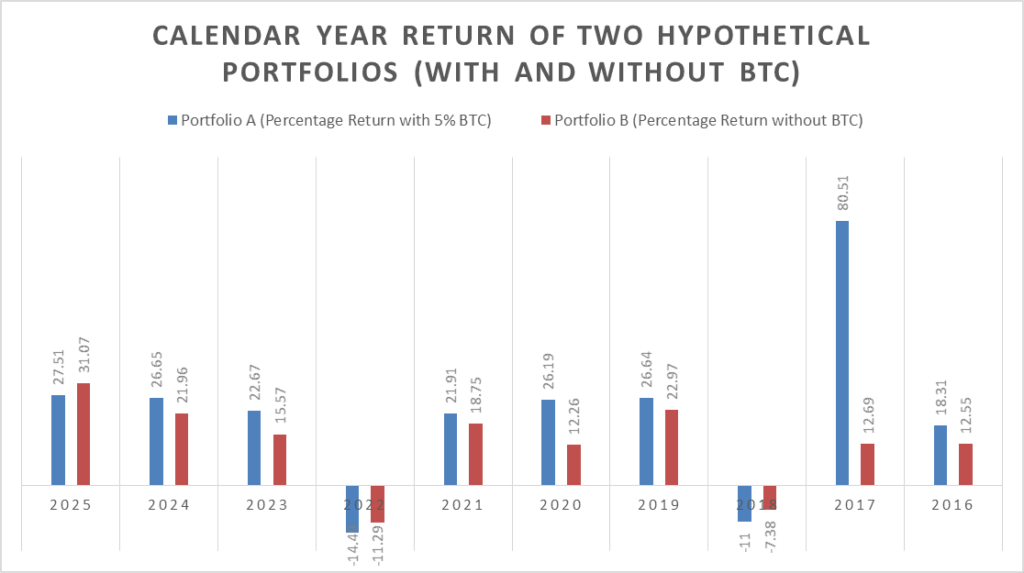
As the table and chart above show, a portfolio with a 5% allocation to BTC would have outperformed one with no crypto exposure in seven of the past 10 years. This helps explain why some investors are considering a small allocation.
But past performance doesn’t tell the whole story. Bitcoin is a highly volatile asset, with prices that can swing sharply over short periods. Any potential upside needs to be weighed against the risk of significant drawdowns, and whether that level of uncertainty fits your overall investment plan.
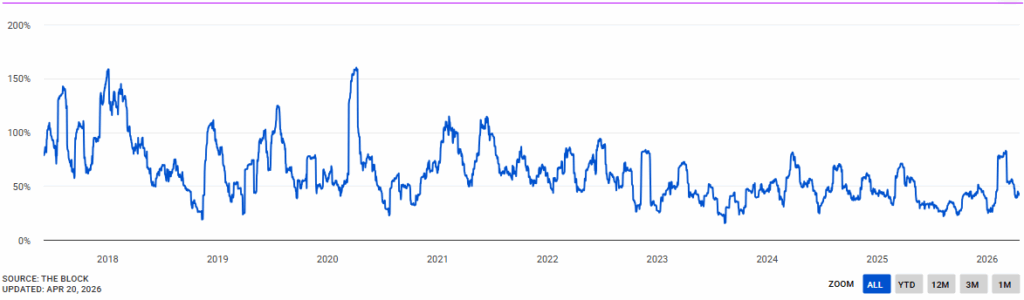
As the crypto market matures and attracts an increasing number of institutional investors, the market is beginning to show signs of increasing stability, one of which is a decline in volatility.
As the chart below shows, BTC’s annualized 30-day volatility has dropped from a high of about 158% in 2018 to its current value of just over 40% on April 20, 2026.
Source: Theblock.co on April 20, 2026
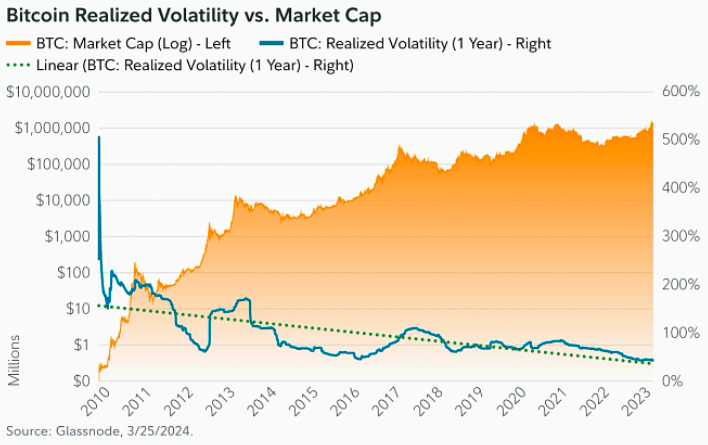
For another perspective, the chart below shows Bitcoin’s volatility relative to its market capitalization over time. While the chart reflects data through 2024, more recent market activity continues to support the same trajectory: as Bitcoin’s market cap has grown, its volatility has generally declined. This pattern helps explain why BTC has drawn increasing interest from some Canadian investors.
It’s important to remember, though, that BTC remains a highly volatile asset and sharp price swings are common.
Source: Fidelitydigitalassets.com on April 20, 2026
In the sections above, I’ve made the case for allocating a small amount of your portfolio to the largest cryptocurrency by far, BTC. But what about the other cryptocurrencies, such as ethereum (ETH), solana (SOL), or XRP, all of which are available to buy and sell through platforms such as Coinbase, which offer access to a range of digital assets.
As of April 20, 2026, BTC accounts for about 60% of the total crypto market; ethereum accounts for 11%. That leaves the rest of the cryptocurrencies with about 29% of the total crypto market capitalization.
If you’re crypto-curious and want to explore the crypto landscape, here’s a table of the top coins based on market capitalization that are available to buy and sell on Coinbase—excluding stablecoins (coins that are pegged to the value of a fiat currency):
| Cryptocurrency | Symbol | Market Capitalization |
|---|---|---|
| Bitcoin | BTC | $1.5 trillion |
| Ethereum | ETH | $277.98 billion |
| XRP | XRP | $88.87 billion |
| Solana | SOL | 49.28 billion |
| Tron | TRX | $31.06 billion |
| Dogecoin | DOGE | $16.04 billion |
Source: Coinmarketcap.com on April 20, 2026
Platforms like Coinbase also provide access to market data, including prices, charts, and market capitalization information, which can help investors compare assets and track performance over time.
Crypto is still evolving, and it may not be the right fit for every investor. But for Canadians who are curious and willing to learn, it’s becoming an increasingly accessible part of the financial landscape. As with any investment, it’s important to understand the risks, and to only invest money you can afford to lose. For those ready to explore, platforms like Coinbase offer a straightforward way to buy, sell, and learn more about the crypto market.
Views are the author’s and not official Coinbase positions. This is for informational purposes only—not investment, legal, or tax advice. We make no guarantees regarding accuracy or future performance. Consult your own advisors.
Coinbase Canada, Inc. is registered as a Restricted Dealer in all provinces and territories of Canada. Trading in crypto assets may result in the loss of invested capital. Content is for informational purposes and is not investment advice. This is not a recommendation to buy or sell a particular digital asset or to employ a particular investment strategy. Past performance is not indicative of future results.
We’ve ranked the best crypto exchanges in Canada.
Share this article Share on Facebook Share on Twitter Share on Linkedin Share on Reddit Share on Email


Which ETFs should you invest in? Which ones best suit your risk tolerance? What about personal ethics? Check out...

We’re looking at how Bitcoin and various other cryptocurrencies have fared in the second half of 2026.

Mining and metals companies reasserted their lead atop the leaderboard in a more muted third quarter.

There are still unique advantages to spousal RRSP accounts, even after the advent of pension splitting.

Use MoneySense's TFSA contribution room calculator to find out how much you can still add to your TFSA this...

Yes, you can execute this combination of mortgage repayment and investing using ETFs. Your options depend on risk and...
FAIR Canada says Canada should maintain restrictions on prediction markets unless broader access is shown to benefit investors and...

When bond yields rise, the effects ripple through the rest of the economy, and Canadians should take note. ...

The Bank of Canada has held interest rates steady for 2026 but some experts predict this may change. Find...

Dollarama raises its sales and store-opening forecasts, Reitmans posts lower earnings, and Corus gets approval for its debt deal.