
Tipping in tough times: How to tip without overspending
As tipping prompts become more frequent and suggested amounts climb, Canadians are feeling the strain. Here’s how to approach tipping thoughtfully without stretching your budget.


Advertisement
As tipping prompts become more frequent and suggested amounts climb, Canadians are feeling the strain. Here’s how to approach tipping thoughtfully without stretching your budget.
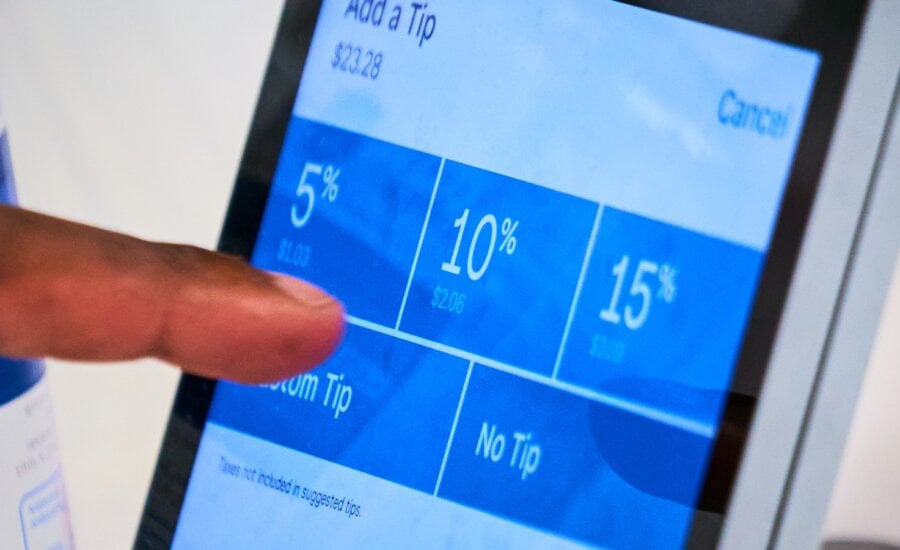
With many Canadians facing greater financial constraints, sentiment around tipping culture is shifting. Over the past few years, customers have seen “suggested” tipping amounts rise, and with more people paying on debit and credit machines instead of cash, they are being asked to tip more often. Some say they are feeling annoyed at a time when they might be strapped for cash even before the bill arrives, but experts say there are ways to mitigate the issue.
“People need to do a bit of soul checking,” said Stacy Yanchuk Oleksy, CEO of Money Mentors. “Just because someone asks for 30% on the machine, it doesn’t mean that’s what it warrants; it doesn’t mean that’s what you have to do. And I think we need to get around the culture of tipping, that it’s become this guilt-laden, ‘If you don’t tip, therefore somehow that says something about you,’” she said. “Sometimes it’s just, you can’t afford it, and that’s OK too.”
Yanchuk Oleksy said she recommends people be intentional about managing their finances and look at their budget to determine what they can afford. For example, it might make sense to pick up their own food instead of tipping for delivery. She said consumers can also decide to tip differently than what is prescribed.

SimplyCash Card from American Express

CIBC Dividend Visa Infinite Card

A recent H&R Block survey found 93% of respondents said they were annoyed when card machines asked for tips on purchases or services that haven’t typically involved gratuities. The same amount said tipping was out of hand and is applied to goods and services they feel are unwarranted.
The survey was conducted from Feb. 19 to Feb. 23 among 1,545 Canadians who are members of the Angus Reid Forum, an online market research platform.
Kelley Keehn, CEO of Money Wise Institute, said that as consumers are being asked to tip at more places, fatigue can set in. “We kind of moved from tipping for service, and now it’s sometimes tipping for transactions,” she said. For sit-down meals at a restaurant, Keehn said it is best to continue to tip to support workers, but for things like counter service, it is more optional. She said it’s also important to factor tipping into a budget, especially for larger ticket items like big family dinners out.
Wayne Smith, a professor and director at the Institute for Hospitality and Tourism Research at Toronto Metropolitan University, said that before the pandemic, it was commonplace to tip about 15% in restaurants. Today, he said, tipping norms are closer to 20% in restaurants, with the increase in the tip percentage coming alongside increases in the overall price due to inflation.
“The tips are really becoming pricey and costly as a result,” he said. “There are a lot of studies starting to be done around Canada where they’re finding that people just aren’t tipping at all.”
The rise in tipping costs also comes as the gap between the rich and poor continues to widen, Smith said, which could have implications for the way Canadians interact with the service industry. “If you want to have a real service encounter with people, it’s going to get really expensive. Otherwise, you’re going to be ordering via your phone, picking up your own stuff … so that gap in the service model is getting wider and wider,” he said.
Overall, Smith said the practice of tipping is a personal choice, and people should tip whatever they feel comfortable with based on their experience.
Neesha Miljanovic, a senior operations manager at Waterworks Food Hall in Toronto, said that sometimes, higher tip options being displayed to customers can push people away from tipping altogether. Instead, she said lower options can allow some businesses to potentially get more tips through volume.
As for her own tipping practices, Miljanovic said there are some rough guidelines she follows.
For a delivery or takeout experience with minimal interaction, she said she rounds up to the nearest zero and orders directly from a business instead of third-party apps. For counter service, she said she tips between 10 and 15% and generally rounds up change to the nearest dollar or two for bar service.
For a restaurant setting, she said there is a range she will tip based on her experience. “15% for me is terrible service, 18% is ‘I’m polite, that was OK,’” Miljanovic said. “20% for me is standard, and then anything above that is an opinion, or a feeling of ‘You really went above and beyond to make my experience incredible here and the whole team did a great job, and I want that to be reflected financially.’”
Overall, she said it’s important for customers to remember that tipping is always voluntary, with the exception of larger groups where gratuity is added automatically.
“You don’t have to tip; the whole thing is supposed to be if you had a good service experience, that you want to give something extra to them, it is not mandatory. On every payment terminal, you can hit zero, you can hit bypass, you can do custom. So there is actually a lot of power in the guest experience to do that,” Miljanovic said.
Share this article Share on Facebook Share on Twitter Share on Linkedin Share on Reddit Share on Email


Who stays in the home? What are the divorce-related rules about mortgages in Canada? A mortgage expert answers questions.

Foreign nationals have been blocked from buying homes in Canada since January 2023, but unless the government takes action...

From dividing rent and bills to tracking shared expenses, here’s how to set expectations with roommates and keep money...

Credit Canada found that 68% of Canadians don’t know how much of their budget goes toward housing. Those who...

With home ownership increasingly out of reach for younger Canadians, some parents are helping their kids buy in by...

Yes, you can execute this combination of mortgage repayment and investing using ETFs. Your options depend on risk and...

Some expenditures stand in for the work required to actually reach our goals. Think of those before you swipe...

Ontario has new rental rules around eviction, late payments, and more. The rules kicked in on Sept. 21.

Should you buy or rent? Our guide breaks down the cost of homeownership vs. renting.

The value of a home during a divorce depends on more than today’s market price. Here’s what to know...
Why would you tip anything at all if the service was terrible? The whole point of tipping is to show that you feel you got the kind of service you wanted or expected. I am not going to tip if my server did not provide a good service.
Great article on Tipping. Should there be a scale for seniors or retirees. In other counties they have a senior card which discounts( 20%)and you can tip back using this amount.
“15% for me is terrible service …..why would you tip 15% for terrible service?
Article says tipping 15% for “terrible service” and 18% for “OK service”. We should need to tip for terrible service!
Here are my comments on my tipping trends in Kingston Ontario:
– In a sit down restaurant, 15% is always the amount I tip, regardless of good or bad service. Tips are inevetibly calculated after HST, so it’s really a 17% tip on the pre-tax bill. Taxes vary across the country; why do we tip on top of them?
– Does anyone tip at McDonalds? No. Why are we tipping at any other fast food (countertop) places? I just hit the red button on the payment keyboard which usually quickly selects no tip.
– What if I don’t want or care about great service today? I just want some food sometimes, not a mystical experience.
– The tips collected are often shared with the business owners too. That is repulsive to me and there’s nothing I can do about it.
– I would much prefer dining/food payment to be a fixed cost transaction, like buying shoes or whatever. No ethereal vagaries about who tips better or who serves better. Good service should be integral to the success of the business, not to the size of the tips.
This is not a re- assuring article at all, especially not when this lady feels that 15% is a terrible service,18% ok and 20% standard? I tip standard what the GST is rounded up to the nearest dollar or perhaps really 15% if I like it. And this has nothing to do with my budget, my logic is always… do I want to. So, to use this Neesha’s logic is counterproductive if you want to explain tipping fatique
At restaurants , tip percentage is recommended even on the taxes(GST) .. ridiculous
It is ridiculous to think that 15% is for terrible service. Why tip if the service is terrible?? For me terrible service is 0%. Good service for me is 15%.
On tipping :
So 15% is for poor service and 20% is standard. This goes on a card that charges 22.9% on balances. And your salary, if you’re lucky may go up 4%. Does any of this make sense.?Percentages are dangerous things,
The standard for tipping I was taught was 15% of the before tax amount. I used to tip 15% on the total bill for good service and less for poor service. Post COVID, when there were shortages of serving staff, I increased that amount. I was happy to tip for counter service also. Now, the world has fully recovered, I think 15% for good service is reasonable at a sit down restaurant. For small bills the percentage may be higher.
I would be interested in what other consumers find is reasonable.
“For a delivery or takeout experience with minimal interaction, she said she rounds up to the nearest zero and orders directly from a business instead of third-party apps. For counter service, she said she tips between 10 and 15%” So when she orders food that is delivered to her home, and the bill comes to $39.95, she’ll give the driver $40.00 (a 5 cent tip), whereas when she orders $40.00 worth of a food at a counter, she’ll give the counter clerk $44.00 to $46.00 ( a $4.00 to $6.00 tip). That doesn’t make any sense at all.
One thing the author forgot to mention is that the tip amount should be calculated on the bill BEFORE sales tax.
Article: Tipping Fatigue
I was surprised you did not address tipping on the total amount of the bill which includes taxes.
I take issue with paying a tip on taxes. Tipping should be calculated on the subtotal so the total before tax is charged people can save money by doing this.
Wow! Neesha Miljanovic tips 15% for “terrible service” and it goes up from there? If someone gives me terrible service in a restaurant they get 0%, with a possible explanation as to why. They have taken away from what was meant to be a pleasant experience. I think Neesha is out of step with what most people do.
“Neesha Miljanovic, a senior operations manager at Waterworks Food Hall in Toronto, said that sometimes, higher tip options being displayed to customers can push people away from tipping altogether. Instead, she said lower options can allow some businesses to potentially get more tips through volume. ”
The tips are supposed to be going to the actual person who provided you with service, not the business. Another reason to be wary!
Most restaurants in our area have listed right on their menu that groups of more than four people automatically have a minimum of 18% gratuity added to each person’s bill. So you don’t get the choices listed in your article.
What’s a reasonable tip in 2026? Why would this article ask as restaurant manager on ‘Whats a reasonable tip in 2026???? 15 % is terrible service??? 0% is terrible service !!!
Next time …please ask the common person who not only is paying higher food prices but is expecte to pay a higher amount even on a 15% tip!