BMO raising chequing fee waiver balances: What changes in February
Three BMO plans need bigger balances, the Plus Plan loses five debit transactions a month, and wire fees go up.


Advertisement
Three BMO plans need bigger balances, the Plus Plan loses five debit transactions a month, and wire fees go up.
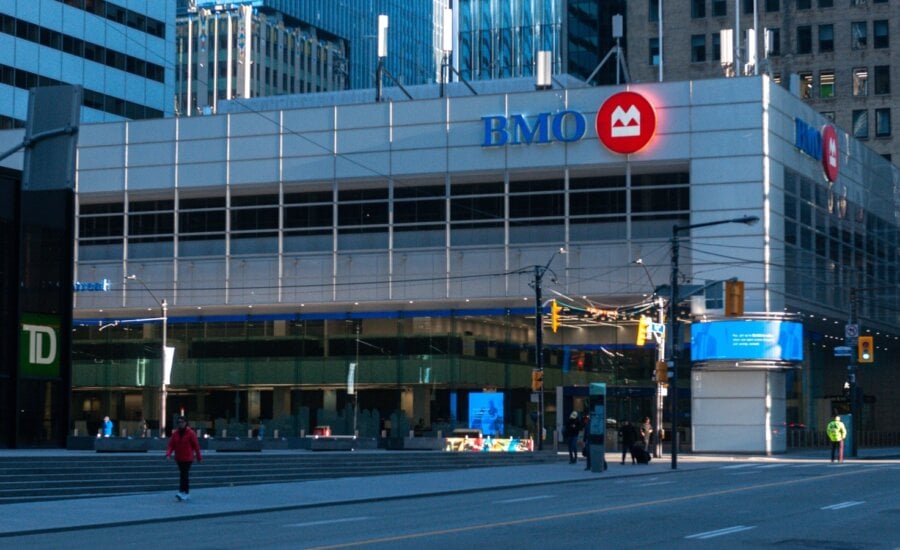
You’ll soon need more money in your BMO chequing account to avoid being charged a monthly plan fee.
BMO is putting new rules in effect on Feb 1. 2027, and that includes cutting the Plus Plan’s monthly debit limit and raising what it charges for wire transfers, according to a customer notice on the bank’s website.
A second set of changes, to the account agreements, takes effect Feb. 21. One of them covers how BMO shares your data with Interac.
The fee waiver on each plan depends on the minimum daily balance in your main chequing account. Monthly fees come from BMO’s plan comparison page.
| Plan | Monthly fee | Waiver balance now | From Feb. 1 | Increase |
|---|---|---|---|---|
| Plus | $12.95 | $3,000 | $3,500 | $500 (16.7%) |
| Performance | $17.95 | $4,000 | $4,500 | $500 (12.5%) |
| Premium | $30.95 | $6,000 | $7,000 | $1,000 (16.7%) |
| Other changes | Now | From Feb. 1 |
|---|---|---|
| Plus Plan debit transactions per month | 25 | 20 |
| Incoming wire | $16 | $17.50 |
| Outgoing wire (wire fee plus $10 communication charge) | $50 | $75 |
If you’re a Plus customer who usually keeps about $3,200 in chequing, make sure you have $3,500 by Feb 1. Otherwise, you’ll start paying $12.95 a month, or $155.40 a year.
Missing the Performance waiver costs $215.40 a year, and missing the Premium waiver costs $371.40.
The balance has to be held every day of the month. BMO’s notice says the waiver applies if you keep the minimum “every day of the month,” and the Financial Consumer Agency of Canada (FCAC) notes that falling short by even $1 means losing it. The waiver also doesn’t work if the account you’ve designated is an Interest Chequing Account (for existing customers) or a Premium Rate Savings Account.
Meeting the higher minimum can cost you something, too. If you carry a credit card balance, every dollar you keep in chequing is a dollar that isn’t paying it down. At 21.99%, a rate FCAC uses in its own examples, an extra $500 in chequing instead of on your card costs about $110 a year in interest.
If you have the Plus Plan, the monthly debit limit drops by 20 per cent. BMO clarifies in its notice that transit fares and passes paid at Canadian transit authorities don’t count toward it.
If you regularly go over 20 transactions, BMO suggests the Performance Plan, which has no transaction limit. That costs $5 more a month than Plus, or $60 a year.
Check how your e-Transfers are counted before you decide. BMO’s plan comparison page says each e-Transfer you send counts toward the limit on the Practical, Plus, Standard, i.connect or Enhanced plans.
Incoming wires go from $16 to $17.50, a $1.50 increase. Outgoing wires rise from $50 to $75, which is $25 more, or 50 per cent.
The outgoing fee is a $65 wire fee (up from $40) plus a $10 communication charge. These apply to personal and business accounts. BMO’s notice also warns that other financial institutions may add their own wire fees, so the total cost of a transfer can be higher than the BMO charge.
BMO says it may share your personal information with Interac Corp. “to prevent, detect and respond to fraud and financial crime” when you use Interac services such as e-Transfer, Interac Debit and Flash.
Interac may combine that information with data from other sources to generate fraud risk indicators. A new clause says your use of Interac services is conditional on these uses, so you can’t opt out and keep using them.
Customers also agree not to put harmful content in an e-Transfer message field, such as illegal material or malicious links, and to follow Canada’s anti-spam legislation. That mostly matters for small businesses that use message fields for promotions. If you live in Québec and disagree with the changes, BMO says you can close your account without cost or penalty within 30 days after they take effect.
Earlier this year, BMO’s Plus Plan fee went from $11.95 to $12.95 and paper statements went from $2.25 to $2.75, according to a notice.
But not every change was difficult for customers. The same notice cut BMO’s non-sufficient funds (NSF) fee from $48 to $10, in line with a federal rule that capped NSF fees at $10 on March 12.
FCAC’s review of banking fees, published in October, found waiver thresholds of $3,000 to $4,500 on standard Big Six plans and $5,000 to $6,000 on premium ones. BMO’s new Plus and Performance thresholds fall inside that range, with Performance at the top. The $7,000 Premium threshold would sit above it.
A Bank of Canada survey found 62 per cent of Canadians with a bank account said they paid a monthly fee in 2023, so the waiver rules affect a lot of people. The same survey noted that 34% had the fee waived or refunded.
Before Feb. 1, start by confirming which plan you’re on.
BMO says it’s printed in the upper right corner of your statement, or you can find it in online banking under Direct deposit info. Then look at your lowest balance over the past few months, not just your average, because if you dip under the new minimum you’ll need to decide whether to top up, move to a cheaper plan or switch banks.
If you’re a Plus customer who’s close to 20 debit transactions a month, weigh the Performance Plan’s extra $60 a year against a lower-cost option. FCAC says every Canadian can open a chequing account with a fee of $4 or less, and BMO’s Practical Plan is $4 with 12 transactions.
BMO also lists no-fee plans for students, newcomers, seniors and others. If you send or receive money abroad a few times a year, price your wires too, since the new $75 outgoing fee adds up and the other bank may charge its own fee on top.
When you’re ready to compare, our best chequing accounts in Canada ranking, updated this month, covers fees, minimums and perks, and our guide to switching to a low-fee or no-fee account walks through the move.
Find the best chequing accounts in Canada using our comparison tool
Share this article Share on Facebook Share on Twitter Share on Linkedin Share on Reddit Share on Email



Presented By
Equifax

Canadian main stock index is down due to losses in baking and mining stocks while U.S. mixed in morning...

This Financial Literacy Month, we discuss how to teach kids about money, give them confidence, and set them up...

Which ETFs should you invest in? Which ones best suit your risk tolerance? What about personal ethics? Check out...

Learn about Alberta Child and Family Benefit payment dates for 2026, plus eligibility rules, benefit amounts, and how the...

Find the Canadian federal and provincial tax brackets for 2026 income. Learn how marginal tax rates work, estimate your...

Bell Canada says it is investigating a recent cyberattack where customer data was compromised. Find out more.

Canada's main stock index and the U.S. stock market soared on Monday as Nvidia reinstated Jensen Huang as CEO....

Compare the best no-fee high-interest savings accounts and find the best one that fits your savings needs. (Updated Nov....